


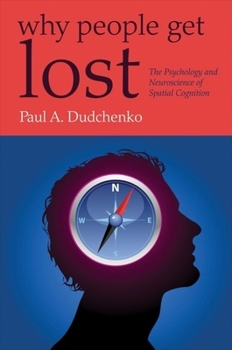
Why People Get Lost: The Psychology and Neuroscience of Spatial Cognition
No Customer Reviews

At some point in our lives, most of us have been lost. How does this happen? What are the limits of our ability to find our way? Do we have an innate sense of direction? 'How people get lost' reviews the psychology and neuroscience of navigation. It starts with a history of studies looking at how organisms solve mazes. It then reviews contemporary studies of spatial cognition, and the wayfinding abilities of adults and children. It then considers how specific
parts of the brain provide a cognitive map and a neural compass. This book also considers the neurology of spatial disorientation, and the tendency of patients with Alzheimer's disease to lose their way. Within the book, the author considers that, perhaps we get lost simply because our brain's
compass becomes misoriented. This book is written for anyone with an interest in navigation and the brain. It assumes no specialised knowledge of neuroscience, but covers recent advances in our understanding of how the brain represents space.
parts of the brain provide a cognitive map and a neural compass. This book also considers the neurology of spatial disorientation, and the tendency of patients with Alzheimer's disease to lose their way. Within the book, the author considers that, perhaps we get lost simply because our brain's
compass becomes misoriented. This book is written for anyone with an interest in navigation and the brain. It assumes no specialised knowledge of neuroscience, but covers recent advances in our understanding of how the brain represents space.
Format:Hardcover
Language:English
ISBN:0199210861
ISBN13:9780199210862
Release Date:September 2010
Publisher:Oxford University Press, USA
Length:320 Pages
Weight:1.45 lbs.
Dimensions:1.1" x 6.2" x 9.2"
Customer Reviews
0 rating
Copyright © 2026 Thriftbooks.com Terms of Use
| Privacy Policy | Do Not
Sell/Share My Personal Information | Cookie Policy | Cookie Preferences | Accessibility Statement
ThriftBooks® and the ThriftBooks® logo are registered trademarks of Thrift Books Global, LLC
ThriftBooks® and the ThriftBooks® logo are registered trademarks of Thrift Books Global, LLC
