


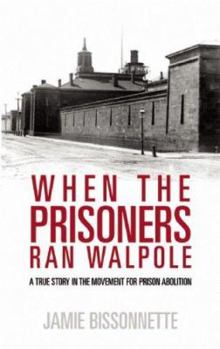
When the Prisoners Ran Walpole: A True Story in the Movement for Prison Abolition

Select Format
Select Condition 
Book Overview
In 1971, Attica's prison yard massacre shocked the public, prisoners, and political leaders across the United States. Massachusetts residents pledged to prevent such slaughter from ever happening... This description may be from another edition of this product.
Format:Paperback
Language:English
ISBN:0896087700
ISBN13:9780896087705
Release Date:April 2008
Publisher:South End Press
Length:272 Pages
Weight:0.85 lbs.
Dimensions:8.9" x 0.5" x 6.0"
Customer Reviews
2 ratings
An optimistic yet critical to both sides of the debate
Published by Thriftbooks.com User , 17 years ago
Is the current prison system in desperate need of reform? "When the Prisoners Ran Walpole: A True Story in the Movement For Prison Abolition" is a look at the concept of prisons and how a group of prisoners in 1973 managed to set forth change successfully, by keeping the peace within their ranks as their guards went on strike. An optimistic yet critical to both sides of the debate, "When the Prisoners Ran Walpole: A True Story in the Movement For Prison Abolition" is highly recommended for community library social issues collections and for any prison administrator.
Can we govern ourselves?
Published by Thriftbooks.com User , 17 years ago
America: less than 1/6 of the world's population - more than 25% of the world's prison population. The 1971 Attica massacre shocked the world into awareness of the pervasive violence perpetrated by state authorities in our prisons. In Massachusetts, voters pledged to prevent such slaughter from ever happening there, and the governor agreed. The reform initiative that resulted led to the prisoners at Walpole's Massachusetts Correctional Institute winning control of its day-to-day operations. The prisoners, working with 1530 civilian volunteers, won control of the operation of a maximum-security prison. The book, authored by a prison abolitionist, reveals what can happen when there is public will for change and trust that the incarcerated can achieve it. In the months before they took over running the maximum-security facility in 1973, prisoners and outside advocates created programs that sent more prisoners home for good, reducing recidivism 23 percent and decreasing Walpole's population by 15 percent. When guards protested the changes they saw as choking their livelihoods, finally refusing to run the prison, the prisoners stepped ably into the void--and all-out peace ensued. They shrank the prison murder rate from the highest in the country to zero. Even more significantly, they worked hard to bury racial antagonism and longstanding feuds so even "lifers" with no hope of going home could find ways to live together, learn, and grow--to regain, finally, the humanity that the system intended to squash. Critical to the work of prison abolitionists and transitional reformists alike, this groundbreaking history offers a real-life example of a prison solution many see only as theoretical. It not only reminds us why people seek to make prisons obsolete, but also recalls a time when we were much closer to these abolitionist goals. The history of Walpole, at its grittiest, shows that we do not need a police state to 'help' us live our lives, and that, in the final analysis, we'd be better of without the so-called 'security' measures provided by the state and the entities of enforcement which under the pretense of 'justice' enforce the inequities resulting from the disregard of human value which must be overcome if we are ever, ever to live peacefully in this world. A history and an argument which could not be more timely and appropo. Rather than trusting in the almighty dollar, or the strength of institutions, recognition of our fellow humanity seems like the best place to begin.
Copyright © 2026 Thriftbooks.com Terms of Use
| Privacy Policy | Do Not
Sell/Share My Personal Information | Cookie Policy | Cookie Preferences | Accessibility Statement
ThriftBooks® and the ThriftBooks® logo are registered trademarks of Thrift Books Global, LLC
ThriftBooks® and the ThriftBooks® logo are registered trademarks of Thrift Books Global, LLC
