


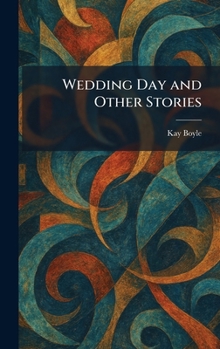
Wedding Day and Other Stories

"Wedding Day and Other Stories" marks the debut collection of short fiction by Kay Boyle, a central figure in the modernist movement and the expatriate literary circle of the 1920s and 30s. This compelling volume showcases Boyle's unique prose style-marked by its precision, lyrical intensity, and psychological depth. Through a series of vignettes and more traditional narratives, Boyle explores the complexities of human intimacy, the fragility of social bonds, and the internal lives of characters navigating a world in flux.
The collection captures the avant-garde spirit of its era, reflecting the influence of Boyle's time spent in Europe among other literary luminaries. Her stories often dwell on the subtle shifts in emotion and perception, rendering the everyday both strange and significant. From the title story to the various sketches that populate the book, readers will find an author grappling with the tension between individual desire and societal expectations. "Wedding Day and Other Stories" is an essential work for those interested in the evolution of the modern short story and the distinctive voice of one of the twentieth century's most significant woman writers. It serves as a testament to Boyle's early mastery of the form and her enduring contribution to literary modernism.
This work has been selected by scholars as being culturally important, and is part of the knowledge base of civilization as we know it. This work was reproduced from the original artifact, and remains as true to the original work as possible. Therefore, you may see the original copyright references, library stamps (as most of these works have been housed in our most important libraries around the world), and other notations in the work.
This work is in the public domain in the United States of America, and possibly other nations. Within the United States, you may freely copy and distribute this work, as no entity (individual or corporate) has a copyright on the body of the work.
As a reproduction of a historical artifact, this work may contain missing or blurred pages, poor pictures, errant marks, etc. Scholars believe, and we concur, that this work is important enough to be preserved, reproduced, and made generally available to the public. We appreciate your support of the preservation process, and thank you for being an important part of keeping this knowledge alive and relevant.
Customer Reviews
ThriftBooks ® and the ThriftBooks ® logo are registered trademarks of Thrift Books Global, LLC
