


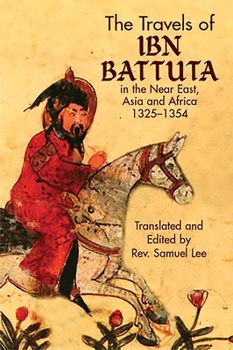
The Travels of IBN Battuta: In the Near East, Asia and Africa, 1325-1354
(Part of the سفرنامه ابن بطوطه Series)


Select Format
Select Condition 
Book Overview
The Arab equivalent of Marco Polo, Sheikh Ibn Battuta (1304-77) set out as a young man on a pilgrimage to Mecca that ended 27 years and 75,000 miles later.
The only medieval traveler known to have visited the lands of every Muslim ruler of his time, Ibn Battuta was born into a family of highly respected religious judges and educated as a theologian. Leaving his native city of Tangier in 1326, he traveled -- over the next several years -- to East Africa, Byzantium, Iraq, southern Russia, India, Ceylon, and China. His account of the journey, dictated on his return, not only provides vivid accounts of an odyssey that took him to exotic lands, but also describes in great detail Muslim maritime activities in the Middle and Far East, fascinating elements of foreign architecture, and agricultural activities of diverse cultures.
A rare and important work covering the geography and history of the medieval Arab world, this primary sourcebook will be welcomed by students and scholars for its inherent historical value.
The only medieval traveler known to have visited the lands of every Muslim ruler of his time, Ibn Battuta was born into a family of highly respected religious judges and educated as a theologian. Leaving his native city of Tangier in 1326, he traveled -- over the next several years -- to East Africa, Byzantium, Iraq, southern Russia, India, Ceylon, and China. His account of the journey, dictated on his return, not only provides vivid accounts of an odyssey that took him to exotic lands, but also describes in great detail Muslim maritime activities in the Middle and Far East, fascinating elements of foreign architecture, and agricultural activities of diverse cultures.
A rare and important work covering the geography and history of the medieval Arab world, this primary sourcebook will be welcomed by students and scholars for its inherent historical value.
Format:Paperback
Language:English
ISBN:0486437655
ISBN13:9780486437651
Release Date:December 2004
Publisher:Dover Publications
Length:243 Pages
Weight:0.82 lbs.
Dimensions:0.5" x 6.1" x 9.2"
Related Subjects
Biographical Biographies Biographies & History Biography & History General History Travel WritingCustomer Reviews
1 rating
A TREASURE NOT LOST: IBN BATTUTA'S TRAVELS
Published by Thriftbooks.com User , 25 years ago
A TREASURE NOT LOST: IBN BATTUTA'S TRAVELS IN ASIA AND AFRICA, 1325-1354In 1354 the Caliph of Morocco commissioned a royal scribe to take down Ibn Battuta's account of his twenty-nine years of travels. The result was an eye-opening recitation from a learned man who participated in the affairs of the world. The book did not surface in the west until 1829.The 1986 version under review here was a new translation by H.A.R. Gibb, Lecturer in Arabic at the School of Oriental Studies, University of London, reprinted by Oriental Books Reprint Corporation at Delhi, India. Gibb treats Ibn Battuta "as a traveler, not as a writer of geography" and wrote it so that "this extract may be of service in introducing to a wider circle of English readers one of the most remarkable travelers of his own or any age." In this work he does the job. The prose is easy to read and comprehend. Gibb's translation does not interfere with Ibn Battuta's narrative style. You believe that it is Ibn Battuta whom you are hearing as you read. The notations throughout the book, as endnotes, are scholarly, although the maps, all by the author, are a little hard to read. There is also an index of names and places, but there is no general index.The stimulus for Battuta's travels stemmed from the "duty laid upon every Muslim of visiting Mecca at least once in his lifetime, so long as it lies within his power to do so.""He was in fact the only medieval traveler who is known to have visited the lands of every Muhammadan ruler of his time," in addition to travels in non-Islamic Turkey, Ceylon, and China. His account of the Maldives "is the earliest descriptive account we possess of the islands and their inhabitants." His pilgrimage in Ceylon to the top of the high mountain known as Adam's Peak is a place unique in the world. Muslim, Hindu and Buddhist alike revere this as the location of the imprint in black rock of the foot of Adam, or a Hindu god, or Buddha, according to their respective beliefs. The reported footprint is over eight feet long.His account of a cowrie exchange in Malli (Mali) alongside the salt exchange there "showed the existence of extensive trade between West Africa and East Africa, as cowrie shells are found only in East Africa." It should also be noted that Gibb gives a brief but helpful account here "of the early negro (sic) empires" in West Africa in an extensive endnote. "The extent of his wanderings is estimated at not less than 75,000 miles without allowing for deviations, a figure which is not likely to have been surpassed before the age of steam." We are lucky to have this translation. It reveals a perspective that could have been lost, were it not for Battuta's keen eye, the royal Moroccan and his scribe, and Gibbs. A.D.Saunders August 8, 2000 ++++++++
Copyright © 2026 Thriftbooks.com Terms of Use
| Privacy Policy | Do Not
Sell/Share My Personal Information | Cookie Policy | Cookie Preferences | Accessibility Statement
ThriftBooks® and the ThriftBooks® logo are registered trademarks of Thrift Books Global, LLC
ThriftBooks® and the ThriftBooks® logo are registered trademarks of Thrift Books Global, LLC
