


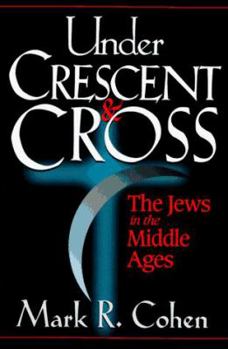
Under Crescent & Cross: The Jews in the Middle Ages


Select Format
Select Condition 
Book Overview
Did Muslims and Jews in the Middle Ages cohabit in a peaceful "interfaith utopia?" Or were Jews under Muslim rule persecuted, much as they were in Christian lands? Rejecting both polemically charged "myths," Mark Cohen offers a systematic comparison of Jewish life in medieval Islam and Christendom--the first in-depth explanation of why medieval Islamic-Jewish relations, though not utopic, were less confrontational and violent than those between Christians and Jews in the West.
Format:Paperback
Language:English
ISBN:069101082X
ISBN13:9780691010823
Release Date:October 1995
Publisher:Princeton University Press
Length:304 Pages
Weight:0.99 lbs.
Dimensions:9.3" x 0.8" x 6.3"
Customer Reviews
5 ratings
Let Us Compare Mythologies
Published by Thriftbooks.com User , 15 years ago
An interesting and scholarly read on the large scale socio-political relationship of Jews in the middle ages. Cohen holds that whereas animosity towards Jews in Christian countries was directed specifically and theologically towards Jews, in the case of the Muslim world Jews generally enjoyed (or suffered) similar treatment to other other dhimmi groups, usually Christians. Chapter 1 compares modern mythologies. The first is that of the shiny happy dhimmi who was both protected and prospered under Islam. Cohen argues that the originated from 19th century Jews hoping to challenge Christian societies to support political emancipation. This gets picked up in 20th century polemics as a statement that Jews and Muslims co-existed as brothers until the advent of modern Zionism. The contrasting myth is that Jews were always second class citizens, victims of a specific intolerance. This serves to give a deeper rational for 20th century Arab and Iranian antisemitism and (a conjecture which I found interesting, but arguable) is sometimes used to raise the status of (or level of empathy towards) Oriental Jews with respect to the narrative of Ashkenazic of pogroms and the Holocaust. Chapter 2 looks at the theological bases for conflict. The Christian vision as the "New Israel" begged the Augustian question that if Christianity replaced Judaism, why were the Jews still around. Islam instead had the doctrine of tarif - that Jews had falsified parts of their Torah and were in error and might still come around. In Christians Muslims had a more numerous competition to deal with than Jews. Chapters 3 and 4:. The Christian Theodosian (later Justinianic) Code barred Jews from obtaining political power over Christians; however Jewish serfs were better off than Christian serfs having many of the rights of freemen to move around where they chose. Jewish rights eroded from 11th and 14th century where Jews lost the right to bear arms and in France Jews became the property of barons of the territory they lived in. In Muslim jurisdictions, governed by the Pact of Umar (pp55), Jews were sometimes allowed to achieve political office - Muslims found more honor in fighting than in state service (pp67) They were not allowed to bear arms - which made them subject to the whims of Qadi's, Sultans, brigands and soldiers. The hated jizya poll tax was collected from every Jewish male of age and in a manner required to symbolically humiliate the payer. Dhimmi merchants paid twice the commercial taxes paid by Muslims. In certain periods the neck would be stamped as proof of payment; Yet Jews feared that non-payment would lead to canceling the Pact and non-protection. In contrast Christendom leaders were bribed to avoid violence against Jews. The uncertainly of this arrangement was less preferable and more onerous. Chapter 5-8 examines money lending, mercantile rights, social relations and residency rights. Both societies got around the p
Explaining difference and tolerance
Published by Thriftbooks.com User , 15 years ago
In this medium-length but magisterial treatment, Cohen seeks the causes of convivencia and the relatively happier lot of Jews under the domination of Islam contrasted with under Christianity during the Middle Ages. His findings are nuanced, equivocal and satisfyingly multi-factored. What he does is to look into causes. What he does not do is try to measure the relative tolerance of the two religious hegemons or ask whether one was more tolerant - he takes this almost as given and seeks to explain it. I regard this as a perfectly legitimate exercise and a perfectly sound starting point, but some reviewers have made it a criticism. If one were trying to rank the two hegemons this criticism would, of course, be perfectly fair, but Gay is not seeking to do this. He is starting from the observation of greater tolerance and looking for reasons. Of course, "tolerance" is an equivocal term, and the difference is not as clear-cut as some would have one believe. The traditional "lachrymose" (tearful) model of Jewish life under Christianity is not the whole story, nor is that of the Golden Age of Samuel ibn Nagrela in Ha Sefarad. Jews living under Christianity in Southern Europe suffered far less persecution than those in the North; Jews living under the Almohads in North Africa were forced to convert to Islam. And then there is Granada and the fate of the Bani Quryaza. Tellingly, though, these last two are generally the only major pogroms that critics of Islam can name, whereas in Europe they were at times systematic and at others an endemic and recurring hazard. The Jews of North Africa, interestingly, appear to have remained crypto-Jews and to have returned to their religion when Almohad fanaticism subsided, whereas Christian-Muslim converts remained Muslim. Quite why this was the case is not explained to my satisfaction. So how does Cohen explain tolerance? Well, as I stated his conclusions are satisfyingly multidimensional. There are circumstantial factors. For instance, Jews were only one of many groups of Dhimmi under Islam, but were the only divergent religious group permitted to survive at all under Christianity with the Augustinian doctrine of "witness" and immiseration, thus receiving the full attention of its spasms of intolerance. There are cultural and economic factors predating the respective religious hegemonies - for instance, that the Arabs were already a mercantile culture prior to Islam and had no strong prejudice against the foreign merchant. There were similar factors post-dating the hegemonies, such as that Jews were restricted by a variety of ordnances and commands to roles like that of moneylender under Christianity, whereas under Islam they were fully integrated into the trades at all levels and in all spheres. Also, Muslim and Dhimmi could intermarry and the spouse legally retain her religion - at least at most times. While a Dhimmi could not be the equal of a Muslim as a consequence of Islam's Establishment, much as a minority
A thought-provoking comparison on Jews under Islam and Christianity
Published by Thriftbooks.com User , 18 years ago
Cohen's book provides a good comparison of the situation of Jews living in Muslim and Christian lands in the Middle Ages. What makes his comparison particularly interesting is the wide range of arenas to which his applies his comparison. After a survey of the historic-theological and legal backgrounds to Christian treatment of Jews and Islamic treatment of Jews, there is a series of discrete chapters on a variety of overlapping aspects of social intercourse. These include economic relations, urbanization, social relations, inter-religious dialogue and dispute, and collective memory. Cohen's analysis is scholarly, dispassionate, and generally apolitical (unlike some of the reviews of his book!). Moreover, with the exception of an introductory chapter to situate the book in modern debates, Cohen limits his examination to the Middle Ages. So, those readers who complain that he ignores trends in modern (since 1750s) or early modern (1500s-1700s) Christianity and Islam are missing the point. I would certainly recommend this book to an educated lay reader or for classroom use.
The Most Balanced and Thorough Study of its Kind. Highly Recommended!
Published by Thriftbooks.com User , 18 years ago
Mark Cohen's comparative study of the status of Jews under Christendom and Islam during the Middle Ages is the most sophisticated, nuanced, meticulous, and persuasively-argued study of its kind. The extremely negative customer review on this page betrays the bias of its author. Citing from Bat Ye'or to demonstrate that the Jewish position in Islam has always been wretched is an exercise in futility. Bat Ye'or is anti-Muslim to an extreme. She thanks "Judeo-Christian" values for the positive treatment Jews currently receive at the hands of the post-Holocaust Western world. As if the previous 1800 years of expulsions, libels, massacres, burnings at the stake, forced conversions, and genocidal attacks pursued in various periods by elements (i.e. states or populaces) loyal to the Catholic Church, the various Eastern Orthodox Churches and, in its first two hundred years, the Protestant Churches as well, never occurred or are somehow irrelevant. It was rather the separation of church and state that resulted from the 18th century Enlightenment that allowed for the fair treatment Jews currently experience in Western countries, although that too must be modified by the brutal pogroms in Russia in which thousands of Jewish men, women, and children were slaughtered, as well as the Holocaust perpetrated by European Christians, some of whom (such as in Croatia) were religious, though most were not. When thousands of Jews across Europe were being burned alive on the streets during the Black Plague (1348 and further), Jews in Muslim lands were able to live and practice their religion, without fear that the local Muslim populations would associate them with the devil and kill them on the basis of outlandish libels. The example of the Black Plague is particularly illustrative of the gap between the medieval Jewish experience under Islam and Christendom, since the Muslim lands were stricken as heavily by this epidemic as the Christian lands, and yet there is not one single recorded instance of Muslims accusing Jews of having been responsible for the plague, whereas in Christian Europe it was just this accusation that was so widespread and consistently served as a pretext for large-scale massacres of Jews. Sure, there were instances of persecution of Jews in Muslim lands, but they were few and far between, and the most significant of the limited number of such persecutions were carried out by heteredox sects such as the fanatical Almohades (Spain, 12th century) and the Caliph al-Hakim (Egypt, Palestine, early 11th century), who was clearly deranged in the most literal sense in the view of most historians. The fact that Jews were discriminated against throughout the Muslim world must be understood in the context of its time: in the Middle Ages, tolerance was not regarded as a virtue, but a weakness, and no one practiced it in the modern sense of the term. Without any doubt, the protected status accorded Jews in return for payment of the discriminatory taxes a
Under Crescent and Cross
Published by Thriftbooks.com User , 24 years ago
It has often been asserted that in medieval times, Jews living in the Muslim lands had it better than their co-religionists in Christendom. Is that assessment accurate? Cohen, professor of Near Eastern Studies at Princeton University, attempts an answer in this first-ever book on the comparative history of Jewish life in the two civilizations.Yes, he concludes, Jews were better off in the Muslim world. In part, this was a matter of physical security. "The Jews of Islam, especially during the formative and classical centuries (up to the thirteenth century), experienced much less persecution than did the Jews of Christendom." Living among Sunni Muslims brought other benefits as well, which Cohen meticulously and convincingly documents: in Dar al-Islam, Jews enjoyed a more regular legal status, they participated far more in the mainstream cultural life, and they had more social interaction with the majority community. In all, Jews living among Muslims were less excluded, making them less vulnerable to assault. Of particular interest, while Christians had a horror of intermarriage, Muslims allowed it on condition that the man was a Muslim. Indeed, Islamic law requires the Muslim husband to permit his Jewish wife to observe her religious rituals, to pray within the family house, to keep the Sabbath, and to maintain the kosher requirements. She may also read her Scriptures, on the important condition that she not do so out loud. Cohen's study ends with the thirteenth century; we would be much in his debt were he to follow this pathbreaking and excellent study with another on the subsequent deterioration of the Jewish position in the Muslim world. Middle East Quarterly, September 1995
Copyright © 2026 Thriftbooks.com Terms of Use
| Privacy Policy | Do Not
Sell/Share My Personal Information | Cookie Policy | Cookie Preferences | Accessibility Statement
ThriftBooks® and the ThriftBooks® logo are registered trademarks of Thrift Books Global, LLC
ThriftBooks® and the ThriftBooks® logo are registered trademarks of Thrift Books Global, LLC
