


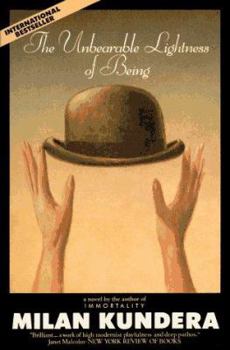
The Unbearable Lightness of Being


Select Format
Select Condition 
Book Overview
International Bestseller - Winner of the Los Angeles Times Book Prize for Fiction"Far more than a conventional novel. It is a meditation on life, on the erotic, on the nature of men and women and love... This description may be from another edition of this product.
Format:Paperback
Language:English
ISBN:0060914653
ISBN13:9780060914653
Release Date:February 1988
Publisher:Harpercollins
Length:314 Pages
Weight:0.66 lbs.
Dimensions:8.1" x 1.1" x 5.1"
Customer Reviews
4 ratings
Beautiful, perspective changing
Published by Bell , 2 years ago
This book changed my perspective of relationships, I think it’s easy to find parts of yourself and others throughout the book. A very good read.
A flawed masterpiece of philosophical fiction
Published by Thriftbooks.com User , 22 years ago
Milan Kundera is an intellectual author of several books of fiction and poetry, plays, and essays. He is even considered by some to be a philosopher. So if you are looking for light reading or erotic literature, then look elsewhere. Even though it is a fairly easy read and it does have a lot of sex, you will be disappointed with this novel. If, however, you are a thinker who loves ideas, a student of philosophy, or a fan of philosophical fiction, then this "book of ideas" is a must read.In this book "lightness" is living superficially, uncommitted, and selfishly without purpose. Weight or "heaviness" is living committed to and loving a spouse, burdened with adherence to and sacrifice for principles that are greater than oneself. In this novel Kundera tells a story of how living a life of lightness is inevitably unbearable, untenable, and that in order to find meaning and peace and happiness in this life, we must take on the weight of commitment and purpose outside ourselves.The philosophy of the novel is essentially existential, and the reader will find many of its concepts operating in the lives of the novel's characters: Life is a series of unique, chance events that the individual experiences in isolation (even though surrounded by people, no one can truly understand the experience of another in the same way); that the universe is indifferent; and that human existence is unexplainable and essentially meaningless; the importance of freedom of choice and responsibility for the consequences of one's actions. But there is a lot more in this novel than just these few concepts - much, much more.I say this novel is flawed because it seems to me to cry out for more rewriting and editing. As it is I call it "near great". It is somewhat disordered, overly sexual, and overly ambitious. It contains too many "philosophical" ideas that are left undeveloped. And it includes a lot of discussion and criticism about Communism and the Soviet "invasion" of Czechoslovakia in the Spring of 1968 (although this does have a profound impact on the main characters in the novel). All of this made the book hard to read and follow, and left me confused as to the intended meaning of the novel. Of course great literature is hardly ever easy, and some brainpower is usually required to "put it all together". And in the case of a great novel like Faulkner's "The Sound and the Fury" figuring out what is going on is half the fun! But in the case of The U. L. of B. I don't think Kundera was trying to write just a great novel. He didn't intend to tell a story that we could figure out completely. His purpose was to engender thought. Not to answer all of life's questions, but to raise some of his own for our consideration and reflection. And at the same time to give us some ideas that may help us to find meaning and happiness and purpose in our own lives. But, even with all the philosophical and intellectual stuff, the novel is still poignant and tender. It even
Beautiful and Thought-Provoking
Published by Thriftbooks.com User , 23 years ago
The world of Milan Kundera's writing is a special place. Long an admirer of his "Book of Laughter and Forgetting," I only recently sat back and read this marvelous novel of love and obsession, lust and oppression. "The Unbearable Lightness of Being" is primarily the tale of a Prague physician, Tomas, who escapes with his wife Tereza to Zurich after the Russian tanks roll over their country in 1968. When his infidelities drive her to leave him and return to Prague he follows her, knowing there will be no other chance to escape Communism. An editorial Tomas has published in an anti-Communist newspaper loses him his license to practice medicine and he soon becomes a window washer. Much to his surprise he's happier for a while in a job he doesn't have to think about ("it's a terrific relief to realize you're free, free of all missions"). Meanwhile, Tereza continues to play the martyr as his philandering increases. The reader is left to wonder whether it is weakness or strength that keeps them together, and how much the lack of political freedom affects the way men and women love each other. Kundera's narrator explores these and other vital questions of being, sometimes with gentle prodding, and others with sudden incisiveness.Writtten in 1984, five years before the Velvet Revolution would draw back the Iron Curtain from Kundera's Czech homeland, "The Unbearable Lightness of Being" is both a product of its era and a timeless work of art. It makes us wonder whether life is difficult because it is heavy, or because the fleetingness of it makes us too light to really make a mark. This novel of heavy concepts is written with such a light touch that the mark it makes cannot be denied. The narrator brings up the German phrase "Einmal ist keinmal": whatever happens once may as well not have happened at all-unlike many other books we read and forget as soon as we finish the last page, this one sticks, even as it cries out to be re-read.
Spell-binding
Published by Thriftbooks.com User , 24 years ago
The Unbearable Lightness of Being by Milan Kundera is the uncanny, carefully structured, multi-layered love story I greatly cherished. More than a love story, the Unbearable Lightness is a full exploration into love and human relationships including disappointment, guilt, devotion and how lovers can grow to hate one another. Tomas is a respected surgeon in Prague, Czechoslovakia, with a die-hard habit of womanizing. Tereza an unhappy, mistreated girl from a small town outside of Prague, is one of his women. Tomas marries her out of a combination of love and pity. Tomas' desire to be a responsible husband creates a conflict with his lifestyle as Tereza's need and adulation of Tomas conflicts with her guilt of changing his lifestyle with Sabina, Tomas's favorite mistress intruding and enjoying it, all creating a spectrum of emotions, all studied and explained from several angles by Kundera, our gentle narrator who simultaneously presents Freudian, metaphysical and historical perspectives. Meanwhile, the book is given a political layer as Communist Russia takes hold of the books' backdrop of Prague. The Unbearable Lightness of Being is unlike any other book I have read. Kundera dissects emotions with the care of a surgeon and the grace of a maestro. Unbearable Lightness is an unforgettable, lyrical and life-altering novel.
Copyright © 2026 Thriftbooks.com Terms of Use
| Privacy Policy | Do Not
Sell/Share My Personal Information | Cookie Policy | Cookie Preferences | Accessibility Statement
ThriftBooks® and the ThriftBooks® logo are registered trademarks of Thrift Books Global, LLC
ThriftBooks® and the ThriftBooks® logo are registered trademarks of Thrift Books Global, LLC
