


The Structure of Production

Select Format
Select Condition 
Book Overview
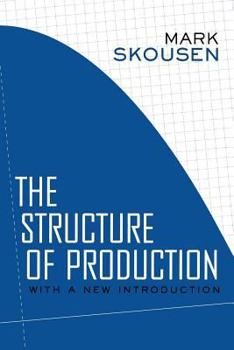
A clash of economic theories continues to dominate into the twenty-first century. The battle lines are drawn between the Keynesian model of aggregate demand and consumer spending, and the supply-side model of capital investment and saving. Which best reflects the dynamics of the booming global economy? Does aggregate demand determine business activity, new technology, and job creation? Or is economic growth driven by the agents of supply-entrepreneurs, capitalists, and savers? Since its release in 1990, The Structure of Production has been the underground bible for supply-side economics and Austrian macroeconomics, and an analytical tool to explain asset bubbles, commodity inflation, and financial instability. Mark Skousen provides a new introduction that updates his four-stage model with new statistical evidence, applications to textbooks, and historical interpretation. He broadens his industrial model into a universal goods-and-services model; updates his "total spending" statistic (now GRE); and applies his time-structural model to recent financial events and government policies. Skousen also introduces new diagrams and models to improve pedagogy in the classroom: the "natural" rate of interest hypothesis; a new micro model using the P&L income statement that explains downsizing, upsizing, and creative destruction dynamics in the global economy; and a pro-saving diagram as an alternative to Keynesian "paradox of thrift."
Format:Paperback
Language:English
ISBN:0814740502
ISBN13:9780814740507
Release Date:June 2007
Publisher:NYU Press
Length:462 Pages
Weight:1.45 lbs.
Dimensions:9.3" x 1.2" x 6.1"
Customer Reviews
1 rating
Understandable and thought provoking
Published by Thriftbooks.com User , 18 years ago
Skousen's explanation of the workings of the economy in terms of the 'aggregate production structure' is, in his own words,' a complete general description of economic activity, taking into account aggregate demand at every level or stage of production (p 364). This fascinating book helps to explain, in simple terms, how the economy works and attempts to come to grips with various aspects of interrelated micro and macro concepts;tying them all together to provide a logical and realistic system of economics. Does he succeed? I still have many questions. And some he himself have been highlighted in the closing chapter on 'The Future of Economic Research'. But what the author does is turn our attention to the important role of capital in the structure of production, and the effects of various monetary policy on this structure. Now the author does much more, but to my mind, these are the two most important contributions that he has made. Skousen also highlights, through his painstaking examination of various authors and theories, that economic development and wealth are only created through due attention to the capital section of an economy. There is no quick way to national development. In doing so, he domolishes the Keynesian allusion that we can 'consume' our way to prosperity- either as a policy of 'national growth' or as a solution to a recession. This book is a must for the serious economics reader. It is readable and understandable. There is no maths and some graphs which are well explained. But there is plenty of is good, solid, verbal economic analysis. Buy this book and you won't be disappointed!
Copyright © 2025 Thriftbooks.com
Terms of Use | Privacy Policy | Do Not Sell/Share My Personal Information | Cookie Policy | Cookie Preferences | Accessibility Statement
ThriftBooks ® and the ThriftBooks ® logo are registered trademarks of Thrift Books Global, LLC
ThriftBooks ® and the ThriftBooks ® logo are registered trademarks of Thrift Books Global, LLC
