


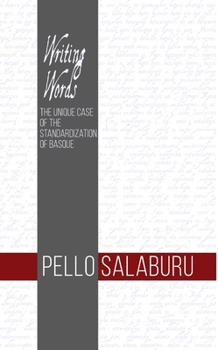
Writing Words: The Unique Case of the Standardization of Basque
No Customer Reviews

All written languages were at some point standardized. In other words, they were subject to a process of searching for and applying coherent standards to their written form so as to be able to organize them for description in grammars and dictionaries and thereby provide a model for use in educational systems, the media, the arts and sciences, government, business, and so on. Pello Salaburu's work is a personal overview of how the Basque language came to standardized-a process involving the unification of a small but dialectically diverse language-and embraced by Basque society in a relatively short period of time compared to many other standardization processes. What makes this story all the more remarkable is the fact that, unlike in most other cases, the Basque Country is not an independent state and is in fact divided along different political and administrative lines. Salaburu describes how the decision to standardize Basque came about, the key figures involved in the process, and the main linguistic issues debated, as well as the subsequent efforts to implement these decisions. This is a fascinating account of how, in the face of a certain degree of adversity, a modern standard written form of Basque was established and how it is thriving today.
Format:Paperback
Language:English
ISBN:1877802360
ISBN13:9781877802362
Release Date:January 2015
Publisher:Center for Basque Studies Press
Length:145 Pages
Related Subjects
Foreign Language Foreign Language Study & Reference Foreign Languages Language ArtsCustomer Reviews
0 rating
Copyright © 2026 Thriftbooks.com Terms of Use
| Privacy Policy | Do Not
Sell/Share My Personal Information | Cookie Policy | Cookie Preferences | Accessibility Statement
ThriftBooks® and the ThriftBooks® logo are registered trademarks of Thrift Books Global, LLC
ThriftBooks® and the ThriftBooks® logo are registered trademarks of Thrift Books Global, LLC
