


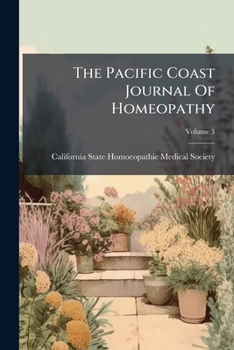
The Pacific Coast Journal Of Homeopathy; Volume 3

Select Format
Select Condition 
Book Overview
"The Pacific Coast Journal Of Homeopathy, Volume 3" offers a comprehensive look into the practice and theory of homeopathy as it was understood and applied in the late 19th and early 20th centuries. Published by the California State Homoeopathic Medical Society, this volume presents a collection of articles, case studies, and discussions relevant to homeopathic practitioners of the time. It serves as a valuable historical record, illustrating the development and adaptation of homeopathic principles within the specific context of the Pacific Coast.
Readers interested in the history of medicine, particularly the evolution of alternative medical practices, will find this journal an insightful resource. It provides a unique window into the challenges and triumphs faced by early homeopathic physicians, their approaches to patient care, and their contributions to the broader field of medicine. This volume is essential for those seeking to understand the roots and continuing relevance of homeopathic medicine.
This work has been selected by scholars as being culturally important, and is part of the knowledge base of civilization as we know it. This work was reproduced from the original artifact, and remains as true to the original work as possible. Therefore, you will see the original copyright references, library stamps (as most of these works have been housed in our most important libraries around the world), and other notations in the work.
This work is in the public domain in the United States of America, and possibly other nations. Within the United States, you may freely copy and distribute this work, as no entity (individual or corporate) has a copyright on the body of the work.
As a reproduction of a historical artifact, this work may contain missing or blurred pages, poor pictures, errant marks, etc. Scholars believe, and we concur, that this work is important enough to be preserved, reproduced, and made generally available to the public. We appreciate your support of the preservation process, and thank you for being an important part of keeping this knowledge alive and relevant.
Customer Reviews
ThriftBooks ® and the ThriftBooks ® logo are registered trademarks of Thrift Books Global, LLC
