


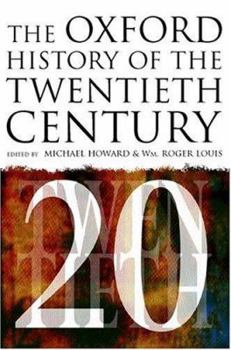
The Oxford History of the Twentieth Century


Select Format
Select Condition 
Book Overview
Of all the centuries in recorded history, none has seen more change, none has ended more differently than it began, than the twentieth. In 1900, Queen Victoria still ruled over England, the Imperial Manchu dynasty over China, and the Romanov Tsars over Russia. The cinema was in its infancy, radio and television still to be invented. The first cars were on the road, but air travel existed only in earthbound imaginations. And now, as Yeats said, all is "changed utterly."
In this ambitious book, twenty-four of the most distinguished scholars in the world survey the momentous events and the significant themes of the twentieth century in compact, scholarly essays. The contributors tackle political issues region by region as well as non-political topics in subjects such as physics, modernism in art, international economics, and the impact of new technologies on culture. We have William H. McNeill on communications, disease, and demography, Alan Ryan on the growth of a global culture, James Patterson on the United States since 1945, Jonathan Spence on China, Lawrence Freedman on the confrontation of the superpowers, Alan Knight on Latin America, Ralf Dahrendorf on the Twenty-First Century, and much more. The authors trace the continuities which have persisted over the past hundred years and analyze the changes which have marked the century's progress. Early chapters take a global overview of the century as a whole, from a variety of perspectives--demographic, scientific, economic, and cultural. Further chapters chart the century's course, continent by continent and region by region, all written by acknowledged experts.
Beautifully illustrated with both color and black and white plates, and with a detailed chronology, suggestions for further reading, and a full index, The Oxford History of the Twentieth Century is an invaluable repository of information and insight about the endlessly fascinating century we live in.
In this ambitious book, twenty-four of the most distinguished scholars in the world survey the momentous events and the significant themes of the twentieth century in compact, scholarly essays. The contributors tackle political issues region by region as well as non-political topics in subjects such as physics, modernism in art, international economics, and the impact of new technologies on culture. We have William H. McNeill on communications, disease, and demography, Alan Ryan on the growth of a global culture, James Patterson on the United States since 1945, Jonathan Spence on China, Lawrence Freedman on the confrontation of the superpowers, Alan Knight on Latin America, Ralf Dahrendorf on the Twenty-First Century, and much more. The authors trace the continuities which have persisted over the past hundred years and analyze the changes which have marked the century's progress. Early chapters take a global overview of the century as a whole, from a variety of perspectives--demographic, scientific, economic, and cultural. Further chapters chart the century's course, continent by continent and region by region, all written by acknowledged experts.
Beautifully illustrated with both color and black and white plates, and with a detailed chronology, suggestions for further reading, and a full index, The Oxford History of the Twentieth Century is an invaluable repository of information and insight about the endlessly fascinating century we live in.
Format:Hardcover
Language:English
ISBN:0198204280
ISBN13:9780198204282
Release Date:December 1998
Publisher:Oxford University Press
Length:480 Pages
Weight:2.44 lbs.
Dimensions:1.5" x 6.5" x 9.4"
Customer Reviews
2 ratings
Good introduction for anyone!
Published by Thriftbooks.com User , 24 years ago
I remember that history was one of my least interested and weakest subjects when I was in junior secondary school. It's not until recently that I started to realize I should know more about what's going on in the world. And I bought this book.This 450-page book consists of 27 chapters, grouped in 5 parts, namely The Framework of the Century, The Eurocentric World 1900-1945, The Cold War 1945-1900, The Wider World, and finally Envoi.Part 1 is an overall review of the century from different points of views, science, technology, economy, politics, culture and art. This gives you a very brief yet concise idea of what the century is like, what happened, and what were eventually the consequences.Part 2, a very exciting part, tells about the politic and military situations in the two world wars.Part 3 is on the post-war period after the second World War. This tells you about the Cold War between the U.S. and the Soviet Union, and its influences.Part 4 is dedicated to the development of areas other than Europe and the U.S. If you are interested in the history of a specific area other than those dominant countries in the century, or if you would like to look wider than just those countries, this part surely gives you what you want.And finally Part 5 concludes the 20th century and looks forward to the 21st century.This book did a very good job in trying to gather different opinions. The 27 chapters were actually written by 26 leading professionals, including Nobel prize winner Steven Weinberg. As each chapter is dedicated to one particular interest, you can easily jump to where you are interested - if that's what you prefer.In conclusion, this book is a very good choice for anyone, who want to widen their world view and know more about the 20th century, a remarkable century in human history that makes today's world the way it is.
Wonderful, Concise, & Thematically Organized Reference Book!
Published by Thriftbooks.com User , 25 years ago
I enjoyed reading this one-volume survey of the events of the 20th century, whose stated editorial objective was to provide a literate and understandable survey of the panorama of change and tumult that so characterized these last hundred years. Given these very real limitations, this essay-driven approach featuring a whole drawer full of celebrated historians is a very satisfying and entertaining way for a reader to gain an interesting, thematic, and absorbing overview of the events of our century. This is a useful reference book that provides authoritative historical sources describing the momentous events as well as significant themes of the 20th century. It is organized both by period and by geographical areas, and commences with an excellent social, economic, and political snapshot of the world as the new century dawns. By employing a number of different essayists to describe various aspects of the unfolding drama, it provides the reader with relatively concise overviews of salient topics without having to muck about in the mind-boggling details some more expansive histories would. In essence, the text neatly describes the major events and phenomena of the century, discussing the various aspects of each, and analyzing the particulars of both social disruptions via shifts of power as well as the remaining elements of social cohesion and continuity. As the reader soon discovers, however, the former far outweigh the latter in the events and trends characterizing the times. Indeed, when one considers the radical departure between what existed throughout the world at the onset of the century as opposed to what prevails at its close, one is moved by the sense that the world had been literally transformed over the hundred-year span. Where once proud and autocratic kings, tyrants and potentates ruled with despotic indifference, now indifferent democracies, uncertain dictatorships, and benignly ignorant despots rule the stage. We've moved from unreliable telegraphs to instant wireless phones, from horse and buggy to space travel, and from death to an early age to whole societies of seniors planning to live well into their eighties and nineties. Where once people lived in splendid isolation from the outside world in a sphere only painfully connected from one community to another by mail, telegraph, and slow travel, we now have instant awareness of all that happens around the globe. So, if some of us are not entirely convinced of the progressive nature of this change, even we have to admit that W. B. Yeats captured the kernel of the times by warning things had "changed utterly".As I mentioned above, this book provides the reader with a quite handy reference tool and a terrific overview, and is organized both in terms of time periods, geographical area, and also thematically around several key master processes that were instrumental influences in the century. It is expressly not the sort of expansive, detailed,
Copyright © 2026 Thriftbooks.com
Terms of Use | Privacy Policy | Do Not Sell/Share My Personal Information | Cookie Policy | Cookie Preferences | Accessibility Statement
ThriftBooks ® and the ThriftBooks ® logo are registered trademarks of Thrift Books Global, LLC
ThriftBooks ® and the ThriftBooks ® logo are registered trademarks of Thrift Books Global, LLC
