


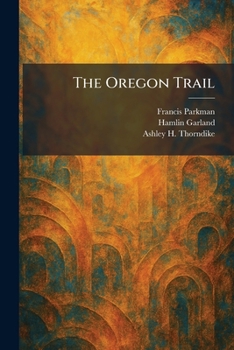
The Oregon Trail


Select Format
Select Condition 
Book Overview
"The Oregon Trail" is a seminal account of the American West, capturing the spirit and challenges of the frontier during a pivotal era of westward expansion. Written by the distinguished historian Francis Parkman, the work documents his 1846 journey from Missouri into the wild territories of the Great Plains and the Rocky Mountains.
Through vivid prose, Parkman provides an immersive look at the lives of the pioneers, the majesty of the landscape, and the culture of the Native American tribes he encountered, particularly the Oglala Sioux. This narrative serves as both a gripping travel memoir and a vital historical record, offering readers a firsthand perspective on the rugged beauty and inherent dangers of the wilderness. As a masterpiece of 19th-century literature, "The Oregon Trail" remains an essential exploration of the American character and the vanishing frontier. Its detailed observations and adventurous spirit continue to captivate those interested in the history of North American exploration and the enduring legacy of the West.
This work has been selected by scholars as being culturally important, and is part of the knowledge base of civilization as we know it. This work was reproduced from the original artifact, and remains as true to the original work as possible. Therefore, you may see the original copyright references, library stamps (as most of these works have been housed in our most important libraries around the world), and other notations in the work.
This work is in the public domain in the United States of America, and possibly other nations. Within the United States, you may freely copy and distribute this work, as no entity (individual or corporate) has a copyright on the body of the work.
As a reproduction of a historical artifact, this work may contain missing or blurred pages, poor pictures, errant marks, etc. Scholars believe, and we concur, that this work is important enough to be preserved, reproduced, and made generally available to the public. We appreciate your support of the preservation process, and thank you for being an important part of keeping this knowledge alive and relevant.
Customer Reviews
Very Interesting
The Old-Old West From One Who Was There
The 1840s Am. Plains from N. America's Greatest Historian
outstanding resource; first-hand description and account
Pioneer Historian
ThriftBooks ® and the ThriftBooks ® logo are registered trademarks of Thrift Books Global, LLC
