


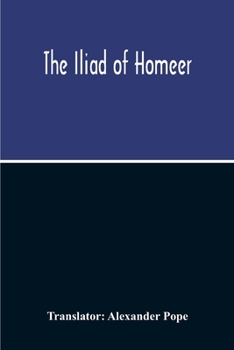
The Iliad Of Homeer

A living thunder of ancient heroism, recast in lyric English. It crackles with heroic force. Alexander Pope's rendering restores Homer's Iliad as an accessible and resonant ancient greek epic poem, where striking imagery and formal technique meet raw human feeling. As a trojan war narrative it traces clashes of ambition and fate without losing the lyric intensity that defines greek mythology stories. Read alongside a heroic poetry anthology or on its own, this edition foregrounds war and honor themes while evoking the heat and dust of bronze age greece and the ancient troy setting. It is immediate enough for casual readers yet rich enough to reward careful study; for those making a homeric epics comparison, Pope's phrasing illuminates eighteenth-century taste and poetic method. Republished by Alpha Editions in a careful modern edition, this volume preserves the spirit of the original while making it effortless to enjoy today - a heritage title prepared for readers and collectors alike. The work's literary significance is plain: one of the notable works of alexander pope, it shaped English poetic responses to antiquity and occupies a secure place in any classical literature collection. Students of classics will find a lively companion; it is equally suited to a homeschool literature curriculum and to those assembling a library of treasured editions. Casual readers and classic-literature collectors alike will be rewarded: dramatic scenes and vivid character draw the uninitiated in, while connoisseurs can savour translation choices, cadence and historical resonance. For those pursuing a homeric epics comparison, this edition highlights how eighteenth-century poetics reframed Homer's themes, offering a fresh angle on bronze age greece and the ancient troy setting. Above all, this Iliad keeps alive the trojan war narrative and the greek mythology stories that continue to shape literature, art and our conversations about heroism. A fine reading companion.
Format:Paperback
Language:English
ISBN:9354213685
ISBN13:9789354213687
Release Date:November 2020
Publisher:Alpha Edition
Length:452 Pages
Weight:1.45 lbs.
Dimensions:1.0" x 6.0" x 9.0"
Customer Reviews
1 rating
The ground is dark with blood.
Published by bernie4444 , 3 months ago
With many books, translations are largely negligible, with two notable exceptions: the Bible and, surprisingly, The Iliad. Each translation can offer a different insight and feel for the story. Everyone will have a favorite. I have several.
There are partial translations that are worth reading, but as with any abridgment or incomplete Iliad, you will never know what is missing.
Be aware of retold versions, as the purpose of the original can be twisted or lost altogether.
Our story takes place in the ninth year of the ongoing war. We get an introduction to the first nine years, but they serve merely as background to this tale of pride, sorrow, and revenge. The story will also end abruptly before the war comes to a close.
We have a wide conflict between the Trojans and Achaeans over a matter of pride; the gods get to take sides and many times direct spears and shields.
Although the more focused conflict is the power struggle between two different types of power. That of Achilles, son of Peleus and the greatest individual warrior, and that of Agamemnon, lord of men, whose power comes from his position.
We are treated to a blow-by-blow inside story as to what each is thinking and an unvarnished description of the perils of war and the search for Arête (to be more like Aries, God of War).
Next, before reading the Odyssey, you will want to bridge the gap with “The War at Troy: What Homer Didn't Tell” by Quintus of Smyrna.
Copyright © 2026 Thriftbooks.com Terms of Use
| Privacy Policy | Do Not
Sell/Share My Personal Information | Cookie Policy | Cookie Preferences | Accessibility Statement
ThriftBooks® and the ThriftBooks® logo are registered trademarks of Thrift Books Global, LLC
ThriftBooks® and the ThriftBooks® logo are registered trademarks of Thrift Books Global, LLC
