


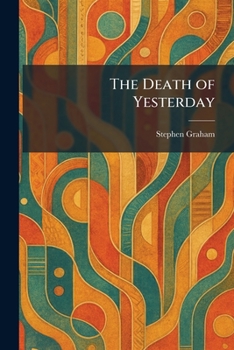
The Death of Yesterday

Select Format
Select Condition 
Book Overview
"The Death of Yesterday" is a compelling collection of essays and literary sketches by the renowned travel writer and journalist Stephen Graham. Written during the interwar period, this work captures the shifting cultural and social landscape of the early 20th century. Graham explores themes of memory, the passage of time, and the profound sense of loss that defined his generation, while also offering insightful commentary on the literary figures and movements of his day.
The collection serves as a bridge between the traditions of the past and the emerging modern age, reflecting on how the "yesterdays" of history are transformed or forgotten. Through his evocative prose, Graham provides readers with a series of vignettes that range from personal anecdotes to broad historical observations. His unique perspective, shaped by extensive travels and a deep engagement with European and Russian culture, lends a global dimension to his reflections. "The Death of Yesterday" remains a significant piece of early modern non-fiction, offering a window into the intellectual and emotional climate of the 1930s and a meditation on the enduring power of the written word to capture the fleeting nature of human experience.
This work has been selected by scholars as being culturally important, and is part of the knowledge base of civilization as we know it. This work was reproduced from the original artifact, and remains as true to the original work as possible. Therefore, you may see the original copyright references, library stamps (as most of these works have been housed in our most important libraries around the world), and other notations in the work.
This work is in the public domain in the United States of America, and possibly other nations. Within the United States, you may freely copy and distribute this work, as no entity (individual or corporate) has a copyright on the body of the work.
As a reproduction of a historical artifact, this work may contain missing or blurred pages, poor pictures, errant marks, etc. Scholars believe, and we concur, that this work is important enough to be preserved, reproduced, and made generally available to the public. We appreciate your support of the preservation process, and thank you for being an important part of keeping this knowledge alive and relevant.
Customer Reviews
ThriftBooks® and the ThriftBooks® logo are registered trademarks of Thrift Books Global, LLC
