


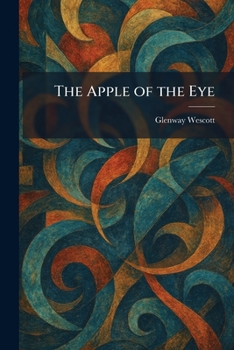
The Apple of the Eye

Select Format
Select Condition 
Book Overview
"The Apple of the Eye" is a profound exploration of the moral and emotional complexities inherent in rural American life. Set against the stark, evocative landscape of southern Wisconsin, the novel follows young Dan Strane as he navigates the formative years of his youth, caught between the rigid, puritanical values of his community and the awakening of his own sensory and emotional desires. Through Wescott's lyrical and precise prose, the narrative unfolds in three distinct parts, each examining the lives of individuals struggling with the weight of tradition, the constraints of religion, and the search for personal liberation.
As a foundational work of Midwestern modernism, "The Apple of the Eye" delves into themes of sexuality, spiritual conflict, and the often-painful transition from innocence to experience. Wescott captures the rhythms of farm life with atmospheric detail, using the natural world as a mirror for his characters' internal struggles. The work stands as a sensitive and psychologically rich portrait of the human condition, highlighting the tension between the physical reality of the earth and the idealistic expectations of the soul. It remains an essential read for those interested in the evolution of 20th-century American literature and the timeless struggle for self-discovery.
This work has been selected by scholars as being culturally important, and is part of the knowledge base of civilization as we know it. This work was reproduced from the original artifact, and remains as true to the original work as possible. Therefore, you may see the original copyright references, library stamps (as most of these works have been housed in our most important libraries around the world), and other notations in the work.
This work is in the public domain in the United States of America, and possibly other nations. Within the United States, you may freely copy and distribute this work, as no entity (individual or corporate) has a copyright on the body of the work.
As a reproduction of a historical artifact, this work may contain missing or blurred pages, poor pictures, errant marks, etc. Scholars believe, and we concur, that this work is important enough to be preserved, reproduced, and made generally available to the public. We appreciate your support of the preservation process, and thank you for being an important part of keeping this knowledge alive and relevant.
Customer Reviews
ThriftBooks® and the ThriftBooks® logo are registered trademarks of Thrift Books Global, LLC
