


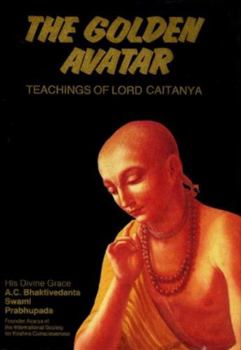
The Golden Avatar


Select Format
Select Condition 
Book Overview
GOURANGA: THE GOLDEN AVATAR Caitanya Mahaprabhu appeared in Bengal, India, in 1486, and He lived for only 48 years, yet He began a revolution in spiritual consciousness that has profoundly affected the lives of millions. Renowned as a great saint even in His youth, Lord Caitanya left His family and friends at the age of 24 to teach the forgotten essence of the ancient Vedic wisdom throughout India. Although He Himself was a fully renounced mystic, He taught how one can act in spiritual consciousness even within one's home, occupation and social affairs. Thus His teachings, although timeless, bear specific relevance for today's world. He taught a practical process that anyone can perform to directly feel the ecstasy of pure love of God. This book tells about the extraordinary life of this great saint and explains the essence of His teachings.Read more
Format:Hardcover
Language:English
ISBN:0912776072
ISBN13:9780912776071
Release Date:October 2008
Publisher:Mandala Publishing
Length:328 Pages
Weight:1.10 lbs.
Dimensions:7.9" x 1.6" x 5.5"
Customer Reviews
3 ratings
AS Deep And Transformational As It Gets
Published by Thriftbooks.com User , 21 years ago
read this book and you will be very happy!
A Review of ?The Teachings of Lord Caitanya?
Published by Thriftbooks.com User , 26 years ago
"The Teachings of Lord Caitanya" by AC Bhaktivedanta Swami informs the reader of the theological tradition begun over 500 years ago in India by Sri Caitanya Saraswati. Some of the major themes discussed include anthropomorphism, polymorphism, and transcendant relationships. The book is structured as conversations with five individuals, reflecting the five modes of relationship defined by Caitanya: passive, servitude, friendship, parental care, and conjugal love.The most prominent theme in the book is the promotion of anthropomorphism. A strong didactic tone is used to deride impersonalists, those who identify the impersonal Brahman as the Ultimate Reality. In this sense, Caitanya can be classified as a Hindu fundamentalist. In every case, literal meaning is preferred to metaphorical interpretation, and sophistication is castigated.One problem in this presentation is the difficulty in translation to English. Not all of the Sanskrit terms are translated, leaving the reader with only a vague understanding. For example: "The personal form of Krsna can be divided into two: svayam-rupa and svayam prakasa. As far as His svayam-rupa (or pastime form) is concerned, it is in that form that He always remains in Vrndavana with the inhabitants of Vrndavana."(p 73) "There are also forms of Krsna which are a little different, and these are called tadekatma-rupa forms. These may be further divided into the vilasa and svamsa forms, which in turn have many different features and can be divided into prabhava and vaibhava forms." (p 75) Although sufficient examples are given to support the theological concept of polymorphism, some of the terms (such as prakasa and tadekatma) remain undefined.One of the least comprehensible portions of the book is the discussion of the relationship between Sri Caitanya and Ramananda Raya. The basis of the depth of their embarrasingly emotional relationship is not clear, and the strange episode establishing Caitanya's divinity is not particularly convincing.This book is pleasant to read. Each chapter flows nicely into the next. But the reader needs to be tolerant of the difficulties mentioned above in order to get the spiritual benefit of the teachings of one of the world's greatest mystics, Sri Caitanya Saraswati. Mike Aigen
Very powerful book!
Published by Thriftbooks.com User , 27 years ago
Anyone who can find and read this book is a very lucky person. I can only say the best about this book which changed my life. And thanks to Prabhupada for putting this book in such a easy-to-read format.
Copyright © 2026 Thriftbooks.com
Terms of Use | Privacy Policy | Do Not Sell/Share My Personal Information | Cookie Notice | Cookie Preferences | Accessibility Statement
ThriftBooks ® and the ThriftBooks ® logo are registered trademarks of Thrift Books Global, LLC
ThriftBooks ® and the ThriftBooks ® logo are registered trademarks of Thrift Books Global, LLC
