


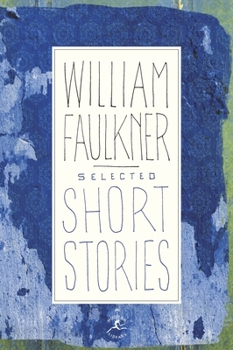
Selected Short Stories


Select Format
Select Condition 
Book Overview
From the Modern Library's new set of beautifully repackaged hardcover classics by William Faulkner--also available are Snopes, As I Lay Dying, The Sound and the Fury, Light in August, and Absalom, Absalom William Faulkner was a master of the short story. Most of the pieces in this collection are drawn from the greatest period in his writing life, the fifteen or so years beginning in 1929, when he published The Sound and the Fury . They explore many of the themes found in the novels and feature characters of small-town Mississippi life that are uniquely Faulkner's. In "A Rose for Emily," the first of his stories to appear in a national magazine, a straightforward, neighborly narrator relates a tale of love, betrayal, and murder. The vicious family of the Snopes trilogy turns up in "Barn Burning," about a son's response to the activities of his arsonist father. And Jason and Caddy Compson, two other inhabitants of Faulkner's mythical Yoknapatawpha County, are witnesses to the terrorizing of a pregnant black laundress in "That Evening Sun." These and the other stories gathered here attest to the fact that Faulkner is, as Ralph Ellison so aptly noted, "the greatest artist the South has produced." Including these stories: "Barn Burning" "Two Soldiers" "A Rose for Emily" "Dry September" "That Evening Sun" "Red Leaves" "Lo " "Turnabout" "Honor" "There Was a Queen" "Mountain Victory" "Beyond" "Race at Morning"
Format:Hardcover
Language:English
ISBN:0679424784
ISBN13:9780679424789
Release Date:May 1993
Publisher:Modern Library
Length:320 Pages
Weight:0.88 lbs.
Dimensions:1.0" x 5.7" x 8.1"
Customer Reviews
5 ratings
GREAT SET OF CLASSICS
Published by Thriftbooks.com User , 18 years ago
This is a great set of classics that I intend to read again. It is from this prolific novelist that we have a countering view that the American good ol' days of the late 19th and early 20th centuries, especially in the South, were actually not so desirable after all. It is by reflecting upon this perspective that I found "A Rose for Emily", "Barn Burning" and "Dry September" to be the most memorable stories. These particular three had a sequence of developments that focused and reflected upon ugly truths that were hidden behind public veneers of "Southern niceties". In essence, the outcomes were essentially America's fictional and somewhat factual answer to the rampant pornography throughout England during what was regarded as the pristine Victorian Era. Also, Faulkner had an uncanny way of depicting how societies with unwritten rules of proper mannerisms would be unraveled thanks to a bullying, uncouth citizen or family. His writing style was that of using actions and events that set the transition from what each person was like at the surface to what he or she was really like all along and how those around him or her would be affected in the aftermath. If you are interested in stories about how a person, individually, might have either gotten along or contrasted with the norms and tones of an immediate culture, especially in rural America, Faulkner is the ideal author. And again, this is an excellent collection for those who want to start reading Faulkner. A slight word of warning: some of you might find it shocking that there were troubles and prejudices that set parts of America on edge, especially if most of your exposure to U.S. History has been largely sanitized. As a recommendation, if you enjoy the stories but find some of the terms unfamiliar or the endings ambiguous, I suggest purchasing William Faulkner A to Z as a reading companion.
A life cannot be complete without Faulkner--
Published by Thriftbooks.com User , 19 years ago
Since reading "A Rose for Emily" as a boy, I have been hooked on Faulkner. I kept a worn out copy on hand to show to my teachers who accused me of using run-on sentences (some of his sentences took an entire page.) He is a true master and when I feel homesick, after being too long in some foreign country, I read a Faulkner story and remember the South where I grew up. "The past is not dead. In fact, it's not even past." --W. Faulkner "Faulkner is the greatest artist the South has produced." --Ralph Ellison
The greatness of the long- distance runner
Published by Thriftbooks.com User , 20 years ago
Just as most athletes excel in one particular event, so many writers find their greatest work in one genre , primarily. Faulkner is an impressive storyteller but the work he is most remembered for is his long- distance works, his novels, "The Sound and the Fury" " Light in August" "Absalom, Absalom" among others. The stories here nonetheless provide a real sense of Faulkner as a writer. The unmistakeable Faulkner style with its complex and Latinate sentences , its cumulative enveloping rhythm, its penetration of the inner lives of its characters, in grotesque and often extreme relationships, including those in which there is often real violence, is here in these stories. Among the stories in this collection are "A Rose for Emily" " Dry September" "That Evening Sun" "Lo" "Red Leaves". Turnabout" . I would say to truly know Faulkner at his best and fullest it is necessary to read the novels. But the stories too give the feeling and flavor of this great American master's work.
Nice Collection
Published by Thriftbooks.com User , 22 years ago
This is a great collection for someone who hasn't read much Faulkner. Everyone needs to have at least read "A Rose For Emily" and "Red Leaves."
WHO'S AFRAID OF WILLIAM FAULKNER?
Published by Thriftbooks.com User , 24 years ago
Faulkner scares readers. Before I read, re-read and loved "Light in August," I had tried books like "Absalom, Absalom" and "The Sound and The Fury" countless times only to get bogged down in the convoluted grammar and personal symbolism as well as the dialogue. For some reason, when I was ready to really read and concentrate, it was certainly not easy, but it was a great, distinct pleasure....one that has stayed with me. Faulkner is, as novelist and essayist Ralph Ellison calls him, "...the greatest artist the South has produced."This Modern Library compilation of some of Faulkner's short stories is a perfect place to start to read this author, or to keep returning for his keen insights into the heart and nature of the Southerners he created from the Southerners he knew. There are thirteen stories here and they include one of Faulkner's most famous, "A Rose For Emily" a tale of great love and, perhaps, necrophilia. My personal favorite, depressingly sad though it is, is "Dry September" which tells of the extreme violence not only of small town whites to blacks but of whites to whites. Every one of these superb stories is a gem, masterfully written. Most were intended for magazines and so are much more straight forward and "simple" than the novels.My only complaint and it is with Modern Library, is that, except in two cases, we are not told when Faulkner wrote the stories nor when they were published. Even so, HIGHLY RECOMMENDED.
Selected Short Stories Mentions in Our Blog
Embracing Faulkner
Published by William Shelton • September 26, 2020
When he was in college, our Regional Director William Shelton was told his writing was like Faulkner! And he…recoiled in disdain. For Faulkner newcomers and fans alike, William’s experience learning to appreciate the classic author gives a great understanding of why Faulkner has made such an impact.
Copyright © 2026 Thriftbooks.com Terms of Use
| Privacy Policy | Do Not
Sell/Share My Personal Information | Cookie Policy | Cookie Preferences | Accessibility Statement
ThriftBooks® and the ThriftBooks® logo are registered trademarks of Thrift Books Global, LLC
ThriftBooks® and the ThriftBooks® logo are registered trademarks of Thrift Books Global, LLC
