


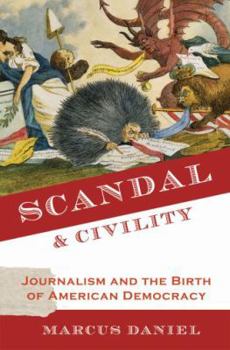
Scandal and Civility: Journalism and the Birth of American Democracy


Select Format
Select Condition 
Book Overview
A new breed of journalists came to the fore in post-revolutionary America--fiercely partisan, highly ideological, and possessed of a bold sense of vocation and purpose as they entered the fray of political debate. Often condemned by latter-day historians and widely seen in their own time as a threat to public and personal civility, these colorful figures emerge in this provocative new book as the era's most important agents of political democracy. Through incisive portraits of the most influential journalists of the 1790s--William Cobbett, Benjamin Franklin Bache, Philip Freneau, Noah Webster, John Fenno, and William Duane--Scandal and Civility moves beyond the usual cast of "revolutionary brothers" and "founding fathers" to offer a fresh perspective on a seemingly familiar story. Marcus Daniel demonstrates how partisan journalists, both Federalist and Democratic-Republican, were instrumental in igniting and expanding vital debates over the character of political leaders, the nature of representative government, and, ultimately, the role of the free press itself. Their rejection of civility and self-restraint--not even icons like George Washington were spared their satirical skewerings--earned these men the label "peddlers of scurrility." Yet, as Daniel shows, by breaking with earlier conceptions of "impartial" journalism, they challenged the elite dominance of political discourse and helped fuel the enormous political creativity of the early republic. Daniel's nuanced and penetrating narrative captures this key period of American history in all its contentious complexity. And in today's climate, when many decry media "excesses" and the relentlessly partisan and personal character of political debate, his book is a timely reminder that discord and difference were essential to the very creation of our political culture.
Format:Hardcover
Language:English
ISBN:0195172124
ISBN13:9780195172126
Release Date:January 2009
Publisher:Oxford University Press
Length:400 Pages
Weight:1.58 lbs.
Dimensions:6.4" x 1.4" x 9.3"
Customer Reviews
1 rating
Taking the issues seriously
Published by Thriftbooks.com User , 16 years ago
Marcus Daniel is on a mission to rehabilitate (or at least better situate) a group of five major newspaper editors from the America of the 1790s from the dismissive attitudes of several generations of historians who bought too much in to that whole press objectivity thing. But here's the cool thing: he's doing it in such a way that us general interest readers can follow along just fine. And he's doing it at a time when a lot of the same handwringing that was going on back then is going on now. Now before I go any further let me state right out that this book would bore many people to if not tears at least reddened, watery eyes. But I really enjoyed it. What I liked most about Scandal and Civility is that Daniel takes his six journalists -- Benjamin Franklin Bache, William Cobbett, Philip Freneau, John Fenno William Duane and Noah Webster -- and sets up their entry in to the field, moves in to their back story and then digs in to their role in the journalism and political battles of the 1790s. The result is that the deeper in to the book you get, the better you understand the issues they were writing about and the more you can contextualize their editorial stances, political ties, reactions to and participation in the discourse of scandal and scurrility, etc. And in the end, Daniel makes his point, I think. That is: partisan journalism wasn't just some ridiculous sideshow, but rather was an important part of the political debates of the time, of the education of both politicians and voters, and of the (still debated) meaning of a free society with a free press. In the end, even one doesn't fully like each of the six men, one at least has an understanding of and perhaps even some admiration of them for sticking to their guns in the face of opposition (including politically-motivated legal action). It also totally explodes the whole model of objective journalism preached (if not actually practiced) for so many years in America. Yeah, these guys could be totally over the top, but at least they weren't trying to cloak their partisanship. As Daniel writes near the end of the book: "They lived in a time of political passion and intense partisan conflict. Like our own. And it was from this conflict that their own great acts of collective political creativity emerged: the Declaration of Independence, the founding of the American Republic, the establishment of the Constitution, and the federal government, the Bill of Rights, the creation of the Supreme Court, and the federal judiciary, and the invention of new institutions to express and organize public opinion, including political parties and a free press. Without such conflict, the political triumphs of the early Republic would have been impossible and even unimaginable. "... As Americans today grapple with the problem of creating a democratic and publicly accountable media, they need to embrace political conflict and difference, the clash of divergent ideological perspectives, and the problems
Copyright © 2026 Thriftbooks.com
Terms of Use | Privacy Policy | Do Not Sell/Share My Personal Information | Cookie Policy | Cookie Preferences | Accessibility Statement
ThriftBooks ® and the ThriftBooks ® logo are registered trademarks of Thrift Books Global, LLC
ThriftBooks ® and the ThriftBooks ® logo are registered trademarks of Thrift Books Global, LLC
