


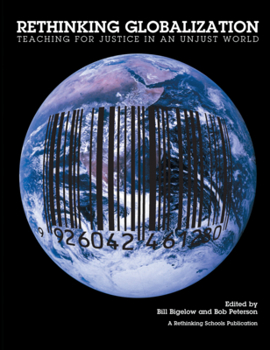
Rethinking Globalization: Teaching for Justice in an Unjust World

This comprehensive 400-page book from Rethinking Schools helps teachers raise critical issues with students in grades 4-12 about the increasing globalization of the world's economies and infrastructures, and the many different impacts this trend has on our planet and those who live here. RethinkingGlobalization offers an extensive collection of readings and source material on critical global issues. Through numerous role-plays, interviews, poems, stories, background readings, cartoons, and hands-on teaching activities, the book offers a memorable introduction to the forces that are shaping the future of our world.
Format:Paperback
Language:English
ISBN:0942961285
ISBN13:9780942961287
Release Date:March 2002
Publisher:Rethinking Schools
Length:400 Pages
Weight:2.07 lbs.
Dimensions:0.8" x 8.3" x 10.7"
Customer Reviews
4 ratings
Incredible tool for ALL levels
Published by Thriftbooks.com User , 17 years ago
I have used this book as a lesson resource to teach middle school and highschool low-level, urban students. The readings are very accessible, and there are games and activities that are fun learning tools. I've borrowed it out to other teachers who have also been impressed.
AWESOME RESOURCE FOR TEACHERS!!!
Published by Thriftbooks.com User , 20 years ago
This book is something that all teachers should invest in. It is such a wonderful book. It's full of great lessons that integrate writing, history, modern-day history, government, reading, and math. It makes students and teachers more aware of the current and pressing world issues in regrads to poverty, colonialism, child labor laws/workers/working conditions, food shortages, and media. The acitivities can be modified for all age ranges and ability levels. The lessons are clearly outlined, all resources are provided, and everything is so well-thought out. I love the integration of poetry--written by students---throughout the book. It really helps when teaching to bring to life and show by example what is expected from students. This book is a breath of fresh-air when coupled with district assigned text books. It will be one of the investments you can make as a teacher. Also look out for their other books--because they have wonderful articles on classroom discipline, sexual harrasment, creating effective classrooms, diversity tranining, and additional wonderful lessons. Rethinking schools is a wonderful organiziation and I am so thankful there are people out there doing such wonderful things for teachers and students!!!!!
Interesting Vignettes on a Variety of Inter-related Topics
Published by Thriftbooks.com User , 21 years ago
Rethinking Globalization, a social studies reader for teachers, presents a variety of essays and classroom activities on the topic of Globalization (yes, with a capital 'g'). The book makes for easy and accessible reading, and one can, after the first 40 or so pages of the book, choose a topic of interest and go from there. The book begins by defining globalization, and placing it firmly in the context of history. It then looks at the various interconnections, from economics and trade to poverty, war and civil strife, and shows how structural elements, both political and economic, have polarized the world into a minority of 'haves' versus a growing majority of 'have nots'. The authors overlooked not a single pressing social issue or current event. Even the awful events of 2001 garnered some comment, and these too, the authors linked to the problems and issues of Globalization. I came away with a deeper understanding of the term, which basically boils down to the wholesale commodification of all of the resources on the planet(aka Earth For Sale, hence the cover picture of the planet with a bar code across it). However, given that at least one of the contributors teaches in an inner city school, I was quite surprised that issues affecting low-income individuals, the Drug Scourge in particular, somehow did not find their way into the text. Yet, while the book is truly global in scope, many of these global issues have their direct counterpart in some very local issues, and I commend the authors for introducing US based sweatshops in an attempt to point this out. Basically, every single cause that has received its fifteen minutes (and only 15 minutes, no more and no less) of fame has found a home under the banner/umbrella of globalization. Ongoing problems such as modernizing forces encroaching on rural and traditional cultures, union-busting via back-door utilization of low-wage labor, interventionism by foreign superpowers in the political, economic and social affairs of foreign lands, and many others received equal treatment in the text. Potential readers of this book should take note, however, of the distinct presence of rhetoric along the lines of colonialism, class struggle and solidarity (especially among the lumpen proletariat), which, though limited in insight and applicability, adds an amusing but rather dubious and tenuous dimension to the text. The presentation of each topic is pretty much even-handed, in the sense that there is no overt idealization of primitive cultures, for example. The book, as well as its authors, do indeed have their biases, and they do the reader a good turn by stating their biases upfront. As such, the text has a level of honesty and openness most uncommon in other books on the topic of Globalization, be they for or against it. Additionally, those with an interest in a particular topic or issue raised in the text will find the resources section of the book most helpful in obtaining more information.
An incredible resource!
Published by Thriftbooks.com User , 22 years ago
Bill Bigelow and Bob Peterson have put together a compendium of articles that attest to their central claim that, when thinking about the globalization phenomenon, "everything is connected. You can't really understand what's going on in one part of the world without looking at how it's related to everything else." Poetry, essays, illustrations, graphs, memoirs, and classroom exercises (one of my favorites: "How do you live on 31 cents a day?", p. 145) are collected that deal with colonialism, sweatshops, child labor, food production and distribution, consumerism and culture, and neoliberal capitalism. The selections are written by some of the best people in the field, and are almost always interesting. My only reservation is that Bigelow and Peterson could've spent more time on the military connection. But then one book can't be expected to do everything.Bigelow and Peterson teach high school and fifth grade, and the anthology was clearly born from their desire to dialogue with their own students about globalization. But the anthology isn't limited to teenagers. It's actually a quite sophisticated and close-to-comprehensive collection that I intend to use in one of my own college classes on peace and justice. It fits a number of audiences nicely--high school, undergraduate college, lay reading.Highly recommended! It would make a great post-Christmas, anti-consumerism gift.
Copyright © 2026 Thriftbooks.com Terms of Use
| Privacy Policy | Do Not
Sell/Share My Personal Information | Cookie Policy | Cookie Preferences | Accessibility Statement
ThriftBooks® and the ThriftBooks® logo are registered trademarks of Thrift Books Global, LLC
ThriftBooks® and the ThriftBooks® logo are registered trademarks of Thrift Books Global, LLC
