


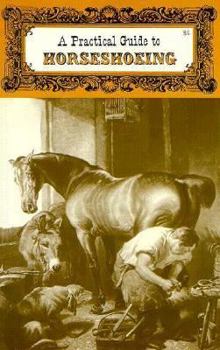
Practical Guide to Horseshoeing

No Synopsis Available.
Format:Paperback
Language:English
ISBN:0879802391
ISBN13:9780879802394
Release Date:January 1981
Publisher:Wilshire Book Co
Length:117 Pages
Weight:0.35 lbs.
Dimensions:8.3" x 0.3" x 5.3"
Customer Reviews
2 ratings
A Varied Success as an Historic Document
Published by Thriftbooks.com User , 20 years ago
As noted in the other review, this book is a reprint of War Department Technical Manual 2-220, The Horseshoer. In that regard it is almost identical to "The Cavalry Horseshoer's Technical Manual" published in 1999. For me, the latter was the better choice of the two since it actually provided the publication date of the original War Department manual, 11 March 1941. Although a small point, I found this to be an important feature since it was obviously not long before there were no more cavalry horseshoers, and this version of the later reprint provided that identification/location along the timeline. To its credit, this book is a little more faithful to the visual style of the original in both its typeface/font and the reproduction of the images. This is not necessarily a good thing since it means the image quality is occasionally pretty poor, as you might expect from a copy of a document that old. If you are really interested in learning aspects of horseshoeing from the U.S. Cavalry, I would recommend that you buy the later publication since the images and drawings are much clearer.
a lot of information in a small package.
Published by Thriftbooks.com User , 25 years ago
This book is a reprint of a small book called `The Horseshoer," which was a reprint of the War Department Technical Manual No. 2-220. It's worth owning this book just for its historical interest and value. It's not a long book - just a little more than 200 pages, but it's full of some of the most interesting and practical information you could want. The book begins with a short description of the basic anatomy and physiology of a horse's foot. Most of the illustrations are clear, but there are some that are difficult to read. The book not only describes how the foot is constructed, but how it works. The horse's foot has always amazed me, and I found this to be one of the most interesting parts of the book. Included in this chapter are some nice figures that show toe-in, straight, and toe-out confirmations.The next section is really quite interesting. It describes the tools used to make the horseshoes from raw iron stock, as well as to fit them to the foot. The figures here are clear and easy to read, with descriptions of the tools and what they are used for. There are the anvil, clinch cutter, forge, rounding hammer, driving hammer, hardy, farrier's knife, creaser, cutting nippers, pincers, hoof parer, farrier's tongs, rasp, pritchel, shoeing box, fire shovel, fire rake, and box-leg vice. There is also a good discussion on machine-made shoes, describing weights and sizes. And, of course, there is a nice discussion about nails, showing different sizes and views.Most readers probably won't use section 4, unless you are a real purist. Section 4 describes how to make horseshoes from bar iron or steel. This chapter is really interesting, and I'd like some day to try making my own shoes, but it takes some pretty specialized skill and equipment. This section has some detailed descriptions about the different parts of the shoe and gives specific detailed instructions about how to form the shoe from a straight bar of material. Section 5 continues the theme with a discussion of borium-treated horseshoes for longer life. This is an interesting piece of history, as encapsulated in the opening paragraph of the section: "Research is being made by various agencies at the disposal of the War Department to develop a method of treating horseshoes with some form of very hard material which will prevent slipping and at the same time increase the wearing qualities on hard surfaced roads." Section 6 is where the book gets down to business, and describes the fundamentals of nailing on the shoe. You can learn a lot from this chapter, but it's best to use what you learn from the book in conjunction with an expert horseshoer. You can do serious damage to a horse by driving the nails incorrectly, or by shaping the hoof incorrectly and throwing it out of balance. This is definitely one of those subjects that can be improved by reading a book, but never learned by reading a book. There are some excellent figures in this section showing the preparation o
Copyright © 2025 Thriftbooks.com
Terms of Use | Privacy Policy | Do Not Sell/Share My Personal Information | Cookie Policy | Cookie Preferences | Accessibility Statement
ThriftBooks ® and the ThriftBooks ® logo are registered trademarks of Thrift Books Global, LLC
ThriftBooks ® and the ThriftBooks ® logo are registered trademarks of Thrift Books Global, LLC
