


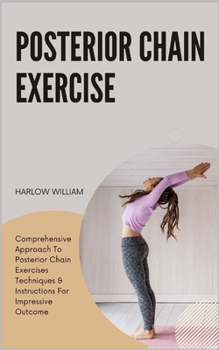
Posterior Chain Exercise Handbook: Comprehensive Approach To Posterior Chain Exercises Techniques & Instructions For Impressive Outcome
No Customer Reviews

A group of muscles that form the back are collectively referred to as the "posterior chain." A system of interconnected muscles, tendons, and fascia, it holds the body together and produces force. The muscles in your back, often known as your "posterior chain," are:
- Gluteal muscles consist of the gluteus maximus, gluteus medius, and gluteus minimus, which all work together to support the buttocks. They help keep everything steady, allow the hips to rotate laterally, and allow the hip joint to expand.
- Semitendinosus, semimembranosus, and biceps femoris are the three muscles that make up the hamstrings. From their location on the back of the thigh, these muscles allow you to bend your knee and straighten your hip.
- As their name suggests, the erector spinae are a group of muscles that work to flex and lengthen the spine in an anterior direction. They help with standing tall, extending the spine, and bending forward.
- The trapezius is a large muscle that connects the back of the neck and shoulders. It helps with shoulder mobility, scapular stabilization, and neck stretching.
- The rhomboids are a set of muscles located in the hollow between your shoulder blades. They help with posture by bringing the shoulders in closer to the spine.
- The posterior deltoids are the back portion of the shoulder deltoid muscle, which consists of three heads. They help when turning the shoulder and abducting the arm to the side.
A strong posterior chain is essential for good posture, maximum power production in exercises like running, jumping, and lifting, and the prevention of front-back imbalances. Conditioning and strengthening practice that concentrates on the posterior chain can improve athletic performance, injury prevention, and general functional strength.
- Gluteal muscles consist of the gluteus maximus, gluteus medius, and gluteus minimus, which all work together to support the buttocks. They help keep everything steady, allow the hips to rotate laterally, and allow the hip joint to expand.
- Semitendinosus, semimembranosus, and biceps femoris are the three muscles that make up the hamstrings. From their location on the back of the thigh, these muscles allow you to bend your knee and straighten your hip.
- As their name suggests, the erector spinae are a group of muscles that work to flex and lengthen the spine in an anterior direction. They help with standing tall, extending the spine, and bending forward.
- The trapezius is a large muscle that connects the back of the neck and shoulders. It helps with shoulder mobility, scapular stabilization, and neck stretching.
- The rhomboids are a set of muscles located in the hollow between your shoulder blades. They help with posture by bringing the shoulders in closer to the spine.
- The posterior deltoids are the back portion of the shoulder deltoid muscle, which consists of three heads. They help when turning the shoulder and abducting the arm to the side.
A strong posterior chain is essential for good posture, maximum power production in exercises like running, jumping, and lifting, and the prevention of front-back imbalances. Conditioning and strengthening practice that concentrates on the posterior chain can improve athletic performance, injury prevention, and general functional strength.
Format:Paperback
Language:English
ISBN:B0CPG3H79W
ISBN13:9798867247812
Release Date:November 2023
Publisher:Independently Published
Length:98 Pages
Weight:0.23 lbs.
Dimensions:0.2" x 5.0" x 8.0"
Customer Reviews
0 rating
Copyright © 2025 Thriftbooks.com
Terms of Use | Privacy Policy | Do Not Sell/Share My Personal Information | Cookie Policy | Cookie Preferences | Accessibility Statement
ThriftBooks ® and the ThriftBooks ® logo are registered trademarks of Thrift Books Global, LLC
ThriftBooks ® and the ThriftBooks ® logo are registered trademarks of Thrift Books Global, LLC
