


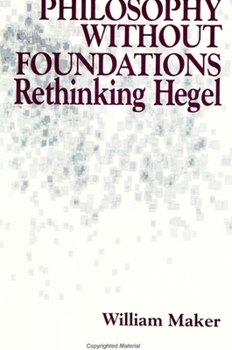
Philosophy Without Foundations: Rethinking Hegel

Select Format
Select Condition 
Book Overview
In an era when philosophy often fragments into competing schools and fashionable skepticism, Philosophy without Foundations returns to one of its most challenging figures to recover a powerful, unifying vision. Through a series of tightly argued and strikingly original essays, William Maker reexamines Hegel not as an abstract metaphysician of the past, but as a rigorously critical thinker whose insights remain vital for confronting the dilemmas of modernity.
Rejecting conventional interpretations, Philosophy without Foundations presents Hegel as a non-foundational and non-metaphysical philosopher, one whose dialectical method opens new possibilities for understanding reason, knowledge, and philosophical method itself. From the problem of beginning philosophy without presuppositions to the role of systematic science, the discussion unfolds with clarity, precision, and intellectual force.
The second part extends this reappraisal into contemporary debates, offering provocative engagements with hermeneutics, Marxism, postmodernism, and transcendental argumentation. Along the way, Maker challenges prevailing assumptions and invites readers to reconsider the place of philosophy in a fractured intellectual landscape.
Written for the thoughtful general reader as well as the seasoned philosopher, Philosophy without Foundations does not demand agreement, it demands reflection. As it unsettles familiar conclusions and reveals overlooked implications, it exemplifies philosophy at its most alive: critical, demanding, and deeply relevant.
Related Subjects
PhilosophyCustomer Reviews
ThriftBooks® and the ThriftBooks® logo are registered trademarks of Thrift Books Global, LLC
