




Select Format
Select Condition 
Book Overview
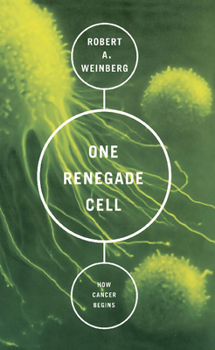
Cancer research has reached a major turning point. The quality and quantity of information gathered about this disease in the past twenty years has revolutionized our understanding of its origins and behavior. No one is better qualified to comment on these dramatic leaps forward than molecular biologist Robert A. Weinberg, director of one of the leading cancer research centers in the world. In One Renegade Cell , Weinberg presents an accessible and state-of-the-art account of how the disease begins and how, one day, it will be cured. Weinberg tells how the roots of cancer were uncovered in 1909 and when the first cancer-causing virus was discovered. He then moves forward to the discovery of the role of chemical carcinogens and radiation in triggering cancer, and relates the remarkable story of the discoveries of oncogenes and tumor suppressor genes, the master controllers of normal and malignant cell proliferation. This book, which presumes little prior knowledge of biology, describes the revolution in biomedical research that has finally uncovered the forces driving malignant growth. Drawing on insights that simply were not available until recently, the discoveries presented in One Renegade Cell have already begun to profoundly alter the way that we diagnose and treat human cancers.
Format:Paperback
Language:English
ISBN:0465072763
ISBN13:9780465072767
Release Date:October 1999
Publisher:Basic Books
Length:176 Pages
Weight:0.56 lbs.
Dimensions:0.5" x 5.3" x 8.0"
Age Range:18 years and up
Grade Range:Postsecondary and higher
Customer Reviews
5 ratings
Excelent entry to cancer biology
Published by Thriftbooks.com User , 21 years ago
There are very few books out that give the reader an overview modern cancer biology. This short book gives a clear picture of a complex and current subject. It uses historical perspective on scientific discovery to enliven the reading. It's well organized and readable without background in biology, but with enough depth to interest biologists in other fields. I also reccomend Robert Weinberg's "Genes and the Biology of Cancer", written with Harold Varmus, which covers the same material in a little more depth.
Must have: great intro and overview of current research
Published by Thriftbooks.com User , 23 years ago
No prior knowledge of cell biology or genetics is required. I have gained an appreciation for the complexity of cancer research thanks to the book. I highly recommend it. You also learn a fair amount of the history of the development of cancer research. And don't think you need to read through hundreds of introductory pages to accomplish this. The book is under 200 pages. Once again: What I found great about the book is it explains very clearly the current thories on how cancer starts and spreads without requiring any prior knowledge in the field. For the scientifically oriented who are interested in the details, it has a big reference and endnote section. 5 stars for sure.
"Cancer 101"
Published by Thriftbooks.com User , 25 years ago
When my mother was diagnosed with cancer a few months ago, I frantically read everything I could lay my hands on to try to understand what was happening to her. As a former English major and flunker-of-high-school science classes, educating myself about the disease was a daunting task. "One Renegade Cell" explains in intelligent but clear language the theories that currently best explain how the disease begins and spreads. In my search for knowledge, I have found many books that explain cancer as though to the Village Idiot. And I have found others that explain it as though to a PhD in Biology. I am truly thankful that Weinberg wrote this rare book that can be enjoyed and understood by the rest of us.
Excellent overview for the nonscientist and scientist
Published by Thriftbooks.com User , 26 years ago
As a scientist, I am familiar with most of the discoveries in cancer research discussed in the book. Weinberg nicely ties them together and explains how one exciting discovery in cancer research led to another. This is an excellent overview of what has been discovered about cancer and what is not known. Weinberg points out that many of the discoveries were from areas of research not directly related to cancer. This book should help the nonscientist understand the complexities of research and why so much time and resources have been required to uncover the mechanisms of cancer. I also highly recommend this book to students at all levels that are interested in any type of research.
The best book about cancer's causes I've ever read
Published by Thriftbooks.com User , 26 years ago
A book I'd recommend to everyone. Robert Weinberg is obviously on the shortlist for a medicine Nobel, and with the acknowledged help of his US editor has produced a wonderfully lucid, exciting book about how science discovered what cancer is and how it works. The link to evolution and Darwinism (at the gene level) is perhaps surprising. but utterly crucial.This is a *fabulous* time to be alive, if you're intelligent and enthralled by knowledge!
Copyright © 2026 Thriftbooks.com Terms of Use
| Privacy Policy | Do Not
Sell/Share My Personal Information | Cookie Policy | Cookie Preferences | Accessibility Statement
ThriftBooks® and the ThriftBooks® logo are registered trademarks of Thrift Books Global, LLC
ThriftBooks® and the ThriftBooks® logo are registered trademarks of Thrift Books Global, LLC
