


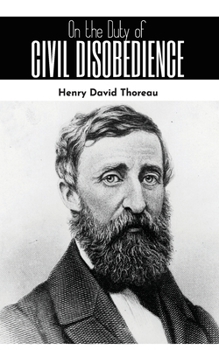
On the Duty of Civil Disobedience

I heartily accept the motto, -"That government is best which governs least;" and I should like to see it acted up to more rapidly and systematically. Carried out, it finally amounts to this, which also I believe-"That government is best which governs not at all;" and when men are prepared for it, that will be the kind of government which they will have. Government is at best but an expedient; but most governments are usually, and all governments are sometimes, inexpedient. The objections which have been brought against a standing army, and they are many and weighty, and deserve to prevail, may also at last be brought against a standing government. The standing army is only an arm of the standing government. The government itself, which is only the mode which the people have chosen to execute their will, is equally liable to be abused and perverted before the people can act through it. Witness the present Mexican war, the work of comparatively a few individuals using the standing government as their tool; for, in the outset, the people would not have consented to this measure.This American government, -what is it but a tradition, though a recent one, endeavoring to transmit itself unimpaired to posterity, but each instant losing some of its integrity? It has not the vitality and force of a single living man; for a single man can bend it to his will. It is a sort of wooden gun to the people themselves; and, if ever they should use it in earnest as a real one against each other, it will surely split. But it is not the less necessary for this; for the people must have some complicated machinery or other, and hear its din, to satisfy that idea of government which they have. Governments show thus how successfully men can be imposed on, even impose on themselves, for their own advantage. It is excellent, we must all allow; yet this government never of itself furthered any enterprise, but by the alacrity 4with which it got out of its way. It does not keep the country free. Itdoes not settle the West. It does not educate. The character inherent in the American people has done all that has been accomplished; and it would have done somewhat more, if the government had not sometimes got in its way. For government is an expedient, by which men would fain succeed in letting one another alone; and, as has been said, when it is most expedient, the governed are most let alone by it. Trade and commerce, if they were not made of India rubber, would never manage to bounce over obstacles which legislators are continually putting in their way; and, if one were to judge these men wholly by the effects of their actions, and not partly by their intentions, they would deserve to be classed and punished with those mischievous persons who put obstructions on the railroad
Format:Paperback
Language:English
ISBN:9387867277
ISBN13:9789387867277
Release Date:March 2023
Publisher:Mjp Publishers
Length:36 Pages
Weight:0.11 lbs.
Dimensions:0.1" x 5.0" x 8.0"
Customer Reviews
1 rating
Henry, you are so radically disobedient.
Published by bernie4444 , 11 months ago
(Original Title: Resistance to Civil Government)
Now (Civil Disobedience)
Occasionally (On the Duty of Civil Disobedience)
I knew that Henry David Thoreau was a tax evader; however, I did not realize how radical he was until I read his book on the duty of civil disobedience.
Sourced from a lecture Thoreau gave in 1848 titled "The Rights and Duties of the Individual in relation to Government"
He starts with "The government is best which governs not at all." This should have tipped me off to what was going to come next.
What would Timothy McVeigh think if he had read this (and he might have):
"Unjust laws exist: shall we be content to obey them, or shall we endeavor to amend them, and obey them until we have succeeded, or shall we transgress them at once?"
Henry David Thoreau's discussion of democracy verging on mob rule or only majority rule could have also incited certain well-known people. If you put your hand over the title and read the sentences, they could've been dropped into "Mein Kampf" and fit very well.
The bottom line in his dissertation is stated:
"There will never be a free and enlightened State until the State comes to recognize the individual as a higher and independent power, from which all its power and authority are derived, and treats him accordingly."
Copyright © 2026 Thriftbooks.com
Terms of Use | Privacy Policy | Do Not Sell/Share My Personal Information | Cookie Policy | Cookie Preferences | Accessibility Statement
ThriftBooks ® and the ThriftBooks ® logo are registered trademarks of Thrift Books Global, LLC
ThriftBooks ® and the ThriftBooks ® logo are registered trademarks of Thrift Books Global, LLC
