


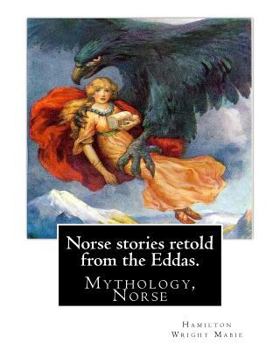
Norse stories retold from the Eddas. By: Hamilton Wright Mabie: Mythology, Norse


Select Format
Select Condition 
Book Overview
Hamilton Wright Mabie, (December 13, 1846 - December 31, 1916) was an American essayist, editor, critic, and lecturer.He was born at Cold Spring, N. Y. in 1846. Mabie was the youngest child of Sarah Colwell Mabie who was from a wealthy Scottish-English family and Levi Jeremiah Mabie, whose ancestors were Scots-Dutch. They were early immigrants to New Amsterdam, New Netherland about 1647. Due to business opportunities with the opening of the Erie Canal his family moved to Buffalo, New York when he was approaching school age. At the young age of 16 he passed his college entrance examination, but waited a year before he attended Williams College (1867) and the Columbia Law School (1869). While at Williams, Mabie was a member of Alpha Delta Phi fraternity and would serve as the first president of the North-American Interfraternity Conference (formally known as the National Interfraternity Conference He received honorary degrees from his own alma mater, from Union College, and from Western Reserve and Washington and Lee universities. Although he passed his bar exams in 1869 he hated both the study and practice of law. In 1876 he married Jeanette Trivett. In the summer of 1879 he was hired to work at the weekly magazine, Christian Union (renamed The Outlook in 1893), an association that lasted until his death. In 1884, Mabie was promoted to associate editor of the Christian Union and then elected to the Author's Club, whose members included such men of established reputation as George Cary Eggleston, Richard Watson Gilder, Brander Matthews, and Edmund Clarence Stedman. In 1890, a small collection of Mabie's essays which reflected upon life, literature and nature were published as a volume entitled My Study Fire"
Format:Paperback
Language:English
ISBN:1539562867
ISBN13:9781539562863
Release Date:October 2016
Publisher:Createspace Independent Publishing Platform
Length:62 Pages
Weight:0.31 lbs.
Dimensions:0.1" x 8.0" x 10.0"
Customer Reviews
2 ratings
excelent book
Published by Thriftbooks.com User , 16 years ago
Excelent book, a documented historical background and well written, with a very complete section about the mythological concepts and deities.
Depends on your purpose.
Published by Thriftbooks.com User , 21 years ago
It's an alright book, nicely written and does indeed have stories from Norse Mythology. It may or may not be for you though. If you just want to read the stories cause you like mythology and folktales, then by all means buy it. It's written in with sentences and paragraphs instead of the poetic forms these stories were originally created. To me it seems to be more for a younger age then your average adult, but that doesn't necessarily subtract from the book. If you were looking to read it for research or personal studies, I'd get a different book. The Eddas may be a little difficult to read at first because of the style of writing, but they are better in terms of research sources. My copies of the Poetic and Prose Edda not only have more details for stories found in this book, but also have stories not put into this book. They also have background notes, definitions of words, and anthropological notes. As far as I'm concerned it's purpose was more towards entertainment then heavy-duty research.
Copyright © 2026 Thriftbooks.com Terms of Use
| Privacy Policy | Do Not
Sell/Share My Personal Information | Cookie Policy | Cookie Preferences | Accessibility Statement
ThriftBooks® and the ThriftBooks® logo are registered trademarks of Thrift Books Global, LLC
ThriftBooks® and the ThriftBooks® logo are registered trademarks of Thrift Books Global, LLC
