


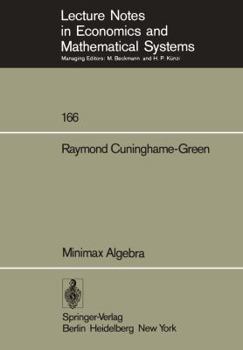
Minimax Algebra
No Customer Reviews

A number of different problems of interest to the operational researcher and the mathematical economist - for example, certain problems of optimization on graphs and networks, of machine-scheduling, of convex analysis and of approx- imation theory - can be formulated in a convenient way using the algebraic structure (R, $, @) where we may think of R as the (extended) real-number system with the binary combining operations x$y, x(R)y defined to be max(x, y), (x+y) respectively. The use of this algebraic structure gives these problems the character of problems of linear algebra, or linear operator theory. This fact hB.s been independently discovered by a number of people working in various fields and in different notations, and the starting-point for the present Lecture Notes was the writer's persuasion that the time had arrived to present a unified account of the algebra of linear transformations of spaces of n-tuples over (R, $, (R)), to demonstrate its relevance to operational research and to give solutions to the standard linear-algebraic problems which arise - e.g. the solution of linear equations exactly or approximately, the eigenvector- eigenvalue problem andso on.Some of this material contains results of hitherto unpublished research carried out by the writer during the years 1970-1977.
Format:Paperback
Language:English
ISBN:3540091130
ISBN13:9783540091134
Release Date:February 1979
Publisher:Springer
Length:258 Pages
Weight:0.98 lbs.
Dimensions:0.6" x 6.7" x 9.6"
Customer Reviews
0 rating
Copyright © 2026 Thriftbooks.com Terms of Use
| Privacy Policy | Do Not
Sell/Share My Personal Information | Cookie Policy | Cookie Preferences | Accessibility Statement
ThriftBooks® and the ThriftBooks® logo are registered trademarks of Thrift Books Global, LLC
ThriftBooks® and the ThriftBooks® logo are registered trademarks of Thrift Books Global, LLC
