
Skip to content
Scan a barcode
Scan
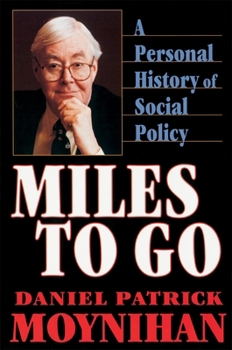
Paperback Miles to Go: A Personal History of Social Policy Book

ISBN: 0674574419

ISBN13: 9780674574410

Miles to Go: A Personal History of Social Policy

Select Format

Select Condition ThriftBooks Help Icon

Recommended

Format: Paperback

Condition: Very Good

$6.69
Save $28.31!
List Price $35.00
Almost Gone, Only 4 Left!
Save to List

Book Overview

Has liberalism lost its way--or merely its voice? This book by one of the nation's most insightful, articulate, and powerful Democrats at last breaks the silence that has greeted the Republican Party's revolution of 1994. When voters handed Democrats their worst defeat in 100 years, New Yorkers returned Daniel Patrick Moynihan to the Senate for his fourth term. Amid the wreck of his party's control and the disarray of programs and policies he has championed for three decades, Senator Moynihan here takes stock of the politics, economics, and social problems that have brought us to this pass. With a clarity and civility far too rare in the political arena, he offers a wide-ranging meditation on the nation's social strategies for the last 60 years, as well as a vision for the years to come.

Because Senator Moynihan has long been a defender of the policies whose fortunes he follows here, Miles to Go is in a sense autobiographical, an exemplary account of the social life of the body politic. As it guides us through government's attempts to grapple with thorny problems like family disintegration, welfare, health care, deviance, and addiction, Moynihan writes of "The Coming of Age of American Social Policy." Through most of our history American social policy has dealt with issues that first arose in Europe, and essentially followed European models. Now, in a post-industrial society we face issues that first appear in the United States for which we will have to devise our own responses. Ringing with the wisdom of experience, decency, and common sense, Miles to Go asks "why liberalism cannot be taught what conservatives seem to know instinctively"--to heed the political and moral sentiments of the people and reshape itself for the coming age.

Customer Reviews

3 ratings

DPM is missed

We could sure use a statesman like Daniel Patrick Moynihan today. A thoughtful book from a thoughtful, highly experienced American. It remains relevant even today.

Thought-provoking but somewhat difficult to follow

In a series of loosely-connected chapters roughly organized around topics such as illegitimacy, welfare, and the rise of drug "epidemics," Moynihan reviews his life, work and positions in social policy. Written in the aftermath of the 1994 Republican takeover of Congress, Moynihan essentially seems to be arguing that liberalism needs to refocus its paradigm. He claims that much of our social policy is rooted in a 19th-century understanding of problems inherent to an industrial economy, and that by and large, these problems have been solved (for example, the problem of stabilizing the economy; he also has some interesting and novel insights on the "health-care crisis," pointing out that in comparison to the 1800s and early 1900s, the health care system has improved immeasurably, not least because we've finally managed to get the medical profession to the point where it actually *doesn't hurt* its patients--now if we could only pull off the same with psychology!) He argues that the problems we are now facing, such as the persistence of poverty in the inner cities, are problems germane to a new kind of *post-industrial* society, and are less amenable to the kinds of social policy solutions that helped deal with the earlier problems. He sees many modern problems as being significantly influenced by what he calls "character" effects. Putting this in less loaded terms, he's essentially arguing that urban poverty is concomitant with various negative social factors--such as fatherlessness, early single motherhood, drug lifestyle, etc.--which at the very least make it more difficult to escape conditions of urban poverty. (There is something to this idea: this is somewhat similar to the thesis put forward by Paul Willis in LEARNING TO LABOR, his study of British working-class youths.) These problems require new manners of approaches in order to deal with them. These approaches, however, have been lacking; partly, Moynihan argues, because liberals have been reluctant to discuss these negative social factors because it goes against political correctness and because it can sound like "blaming the victim." His stance against welfare reform comes across a little too much as "Think of the children! Won't somebody *please* THINK of the CHILDREN!" hysteria, and his apocalyptic predictions about mass homelessness, etc. were not borne out (see DeParle's book THE AMERICAN DREAM for a thorough exploration of this topic, but essentially it turned out that welfare recipients were a lot less dependent on welfare and a lot more able to find jobs than many on the left had thought--which isn't to say, by the way, that welfare reform worked). His rhetoric on crime also comes across as exaggerated and unreliable. For example, at one point he attempts to buttress an argument by comparing supposed lists of biggest problems faced by schools in the 1940s (chewing gum, running in halls, etc.) vs the 1990s (teen pregnancy, suicide, drugs.) This is an urban legend whi

A wealth of wisdom

I must first note that this book is extremely poorly edited. It oscillates from current commentary to previously published essays and articles without significant distinction. This along with an introduction that occupies a third of the book makes for a frustrating read. Moreover, Moynihan doesn't always state what he is trying to say so the reader must be alert for not-so-obvious implications.Having said all this, this book is a true resevoir of wisdom. In tackling issues from moral decline to welfare reform to the drug war to "Reaganism," Moynihan both parts ways with contemporary liberalism while offering sharp critiques of past and current policies. Ever the social scientist, Moynihan is quick to demonstrate how "conventional wisdom" can be utterly wrong while at the same time dismissing those who would sieze on simplistice generalizations of scientific research in furtherance of radical agendas.A difficult read but well worth it.
Copyright © 2026 Thriftbooks.com Terms of Use | Privacy Policy | Do Not Sell/Share My Personal Information | Cookie Policy | Cookie Preferences | Accessibility Statement
ThriftBooks® and the ThriftBooks® logo are registered trademarks of Thrift Books Global, LLC

GoDaddy Verified and Secured