


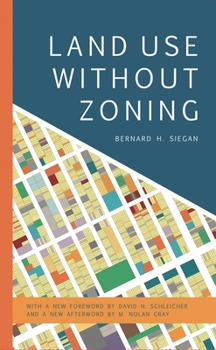
Land Use without Zoning

Select Format
Select Condition 
Book Overview
The conversation about zoning has meandered its way through issues ranging from housing affordability to economic growth to segregation, expanding in the process from a public policy backwater to one of the most discussed policy issues of the day. In his pioneering 1972 study, Land Use Without Zoning, Bernard Siegan first set out what has today emerged as a common-sense perspective: Zoning not only fails to achieve its stated ends of ordering urban growth and separating incompatible uses, but also drives housing costs up and competition down. In no uncertain terms, Siegan concludes, "Zoning has been a failure and should be eliminated "
Drawing on the unique example of Houston--America's fourth largest city, and its lone dissenter on zoning--Siegan demonstrates how land use will naturally regulate itself in a nonzoned environment. For the most part, Siegan says, markets in Houston manage growth and separate incompatible uses not from the top down, like most zoning regimes, but from the bottom up. This approach yields a result that sets Houston apart from zoned cities: its greater availability of multifamily housing. Indeed, it would seem that the main contribution of zoning is to limit housing production while adding an element of permit chaos to the process.
Land Use Without Zoning reports in detail the effects of current exclusionary zoning practices and outlines the benefits that would accrue to cities that forgo municipally imposed zoning laws. Yet the book's program isn't merely destructive: beyond a critique of zoning, Siegan sets out a bold new vision for how land-use regulation might work in the United States.
Released nearly a half century after the book's initial publication, this new edition recontextualizes Siegan's work for our current housing affordability challenges. It includes a new preface by law professor David Schleicher, which explains the book's role as a foundational text in the law and economics of urban land use and describes how it has informed more recent scholarship. Additionally, it includes a new afterword by urban planner Nolan Gray, which includes new data on Houston's evolution and land use relative to its peer cities.
Customer Reviews
Houston, Texas has NO ZONING!
ThriftBooks® and the ThriftBooks® logo are registered trademarks of Thrift Books Global, LLC
