


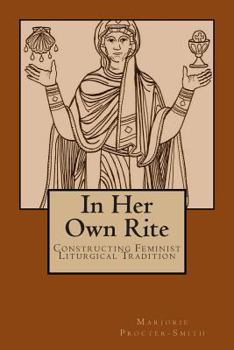
In Her Own Rite: Constructing Feminist Liturgical Tradition

In a major updating of a classic text, Procter-Smith offers us the foundational work in feminist liturgical study that made this book a standard at its first publication. Procter-Smith addresses the... This description may be from another edition of this product.
Format:Paperback
Language:English
ISBN:1492165360
ISBN13:9781492165361
Release Date:September 2013
Publisher:Createspace Independent Publishing Platform
Length:208 Pages
Weight:0.63 lbs.
Dimensions:0.4" x 6.0" x 9.0"
Customer Reviews
1 rating
Behold, I make all things new...
Published by Thriftbooks.com User , 22 years ago
I first read 'In Her Own Rite' a decade ago, shortly after the initial publication of the book. At this time, I was in a church that had a woman as assisting priest, and another woman was being supported in her discernment of a priestly vocation. Prior to this, I had experienced women as chaplains, service leaders, etc. - I had never known a time or situation in which women were specifically and institutionally excluded. Perhaps in my ignorance, I assigned the more pressing issues of the feminist struggle to the past. Britain had had a very successful female Prime Minister, as had many nations. Women were rising in the ranks of all professions. Surely the worst aspect of male-dominated cultural exclusion of women was over.So, it was with great surprise that found Proctor-Smith's statements about the continuing problems and issues. Issues of memory, inclusion, participation, and recognition were vibrant and alive. Particularly in the liturgical and theological realms, there was a long way to go - we had only begun to make strides toward something resembling equality. And, in fact, this may be the wrong term. As Proctor-Smith says, to work with feminist spirituality is to indicate on whose behalf one's spirituality is engaged, as a woman-identified spirituality, a manner of being in the world that is ultimately accountable to women (p. 165). This is not equality - certainly not an equality in every respect. There are definite ways in which women's experience, learning, and understanding, particularly for other women, will be superior. There is a difficulty in the way historical norms and authority has come down to us - the role of women has been neglected or erased, their presence as well as right to participate in much of the liturgy removed, and even the names of women have been forgotten, which Proctor-Smith relates to the Jewish idea of death being the forgetting of names. Proctor-Smith concludes not with a sense of despair, but with a call to action and a sense of hope. She names specific spiritual disciplines for women, which require strength and integrity to pursue (as do all valuable spiritual disciplines); she likewise names those things men can do to aid this process. Perhaps in this part she would find the most resistance from many other feminists, for she calls on men not necessarily to give up power, but to use it on behalf of women.I would like to know if Proctor-Smith sees this as a process with criteria for success, i.e., an adequate balance and mutual respect in liturgical practice (and in society generally) such that women will feel fully present without men losing identity and presence also. She touches on a few dangers: of women sometimes, in initial formation of feminist groups, distrusting any authority or talent as being patriarchal; of women sometimes co-opting and duplicating patriarchal forms of hierarchy, simply with a women as leader; and of women disengaging entirely from the wider world. Perhaps it is hard to see the
Copyright © 2026 Thriftbooks.com Terms of Use
| Privacy Policy | Do Not
Sell/Share My Personal Information | Cookie Policy | Cookie Preferences | Accessibility Statement
ThriftBooks® and the ThriftBooks® logo are registered trademarks of Thrift Books Global, LLC
ThriftBooks® and the ThriftBooks® logo are registered trademarks of Thrift Books Global, LLC
