


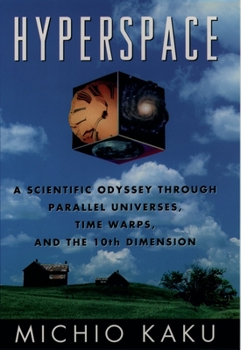
Hyperspace


Select Format
Select Condition 
Book Overview
Are there other dimensions beyond our own? Is time travel possible? Can we change the past? Are there gateways to parallel universes? All of us have pondered such questions, but there was a time when scientists dismissed these notions as outlandish speculations. Not any more. Today, they are the focus of the most intense scientific activity in recent memory. In Hyperspace, Michio Kaku, author of the widely acclaimed Beyond Einstein and a leading theoretical physicist, offers the first book-length tour of the most exciting (and perhaps most bizarre) work in modern physics, work which includes research on the tenth dimension, time warps, black holes, and multiple universes.
The theory of hyperspace (or higher dimensional space)--and its newest wrinkle, superstring theory--stand at the center of this revolution, with adherents in every major research laboratory in the world, including several Nobel laureates. Beginning where Hawking's Brief History of Time left off, Kaku paints a vivid portrayal of the breakthroughs now rocking the physics establishment. Why all the excitement? As the author points out, for over half a century, scientists have puzzled over why the basic forces of the cosmos--gravity, electromagnetism, and the strong and weak nuclear forces--require markedly different mathematical descriptions. But if we see these forces as vibrations in a higher dimensional space, their field equations suddenly fit together like pieces in a jigsaw puzzle, perfectly snug, in an elegant, astonishingly simple form. This may thus be our leading candidate for the Theory of Everything. If so, it would be the crowning achievement of 2,000 years of scientific investigation into matter and its forces. Already, the theory has inspired several thousand research papers, and has been the focus of over 200 international conferences.
Michio Kaku is one of the leading pioneers in superstring theory and has been at the forefront of this revolution in modern physics. With Hyperspace, he has produced a book for general readers which conveys the vitality of the field and the excitement as scientists grapple with the meaning of space and time. It is an exhilarating look at physics today and an eye-opening glimpse into the ultimate nature of the universe.
The theory of hyperspace (or higher dimensional space)--and its newest wrinkle, superstring theory--stand at the center of this revolution, with adherents in every major research laboratory in the world, including several Nobel laureates. Beginning where Hawking's Brief History of Time left off, Kaku paints a vivid portrayal of the breakthroughs now rocking the physics establishment. Why all the excitement? As the author points out, for over half a century, scientists have puzzled over why the basic forces of the cosmos--gravity, electromagnetism, and the strong and weak nuclear forces--require markedly different mathematical descriptions. But if we see these forces as vibrations in a higher dimensional space, their field equations suddenly fit together like pieces in a jigsaw puzzle, perfectly snug, in an elegant, astonishingly simple form. This may thus be our leading candidate for the Theory of Everything. If so, it would be the crowning achievement of 2,000 years of scientific investigation into matter and its forces. Already, the theory has inspired several thousand research papers, and has been the focus of over 200 international conferences.
Michio Kaku is one of the leading pioneers in superstring theory and has been at the forefront of this revolution in modern physics. With Hyperspace, he has produced a book for general readers which conveys the vitality of the field and the excitement as scientists grapple with the meaning of space and time. It is an exhilarating look at physics today and an eye-opening glimpse into the ultimate nature of the universe.
Format:Hardcover
Language:English
ISBN:0195085140
ISBN13:9780195085143
Release Date:March 1994
Publisher:Oxford University Press
Length:384 Pages
Weight:1.66 lbs.
Dimensions:1.4" x 6.5" x 9.5"
Customer Reviews
3 ratings
great airplane book
Published by Thriftbooks.com User , 19 years ago
I say great airplane book because I fly internationally a lot and this book is ALWAYS in my carry-on. Even though I've read it probably 30 times through, I never skip chapters, it still is a great read each time. I'm trying to do the "physics by osmosis" method of learning.
a good book for contemplating the inifinte
Published by Thriftbooks.com User , 23 years ago
This is book definitely written for the layperson, but the author does no condescension when explaining complex details to the reader. No deep mathematics, no proofs, just a good book for the average person to enjoy and understand. The best book on the market for understanding the complications of the limitations of the space-time continuum of the world we live in.Don't confuse "hyperspace" with "hypercube". "Hypercube" is a study in mathematics regarding four dimensions without time, while this book discusses as much in detail about "hyperspace", a study of dimensions up to ten. The book is actually on the higher study of physics, not mathematics, but of course, mathematics is a part of the book, if only on a limited basis.Very interesting on the string theory, where dimensions of 10 and/or 26 are required. Also, all the competing theories are discussed, including the fact that Einstein himself was uncomfortable with studies beyond the fourth dimension. This is all discussed, very aptly, with a view to have the reader himself put on the physicist's shoes, so to speak, and comprehend creating some of theses theories, along with the rest of the academia bunch.Diagrams and pictures are included to help the reader visualize some of this, even if it is in a limited way. Very helpful. Einstein claimed that imagination was more than 90 percent of true scientific inquiry. I wouldn't agree with him entirely, especially in fields such as biology, but for physics study and a good review of the all the theories concerning higher dimensions, I would agree more with Einstein than not. I would even recommend this book to one comtemplating a future serious study in physics or math. I wouldn't be without it.
A jouney into higher dimensional reality
Published by Thriftbooks.com User , 25 years ago
Though it is impossible to visualize higher dimensions and difficult for most of us to understand the equations involved in this technical field, Michio Kaku, who has become the "Carl Sagan" of our time, does an excellent job of helping lay readers comprehend hyperspace. The concept of higher dimensions, which was formerly introduced in 1854 by Geog Riemann, was not taken seriously because it was an untestable theory and lost credibility upon the introduction of quantum theory in the early twentieth century. Reinman believed that the forces of nature such as electricity, magnetism, and gravity were just effects caused by the crumpling or warping of hyperspace, an idea that Albert Eisntein revived in his theory of general relativity. In this comprehensive and often humouous work, Kaku takes the reader from the fictional characters of Charles Hinton to Relativity and String theories; both of which have revived interest in higher dimensional reality. If you thought, like me, that you could never come close to understanding the concepts of hyperspace, this book will surely bring you within reach of this understanding, while providing a sound background in the history and development of higher dimensions.
Copyright © 2026 Thriftbooks.com Terms of Use
| Privacy Policy | Do Not
Sell/Share My Personal Information | Cookie Policy | Cookie Preferences | Accessibility Statement
ThriftBooks® and the ThriftBooks® logo are registered trademarks of Thrift Books Global, LLC
ThriftBooks® and the ThriftBooks® logo are registered trademarks of Thrift Books Global, LLC
