


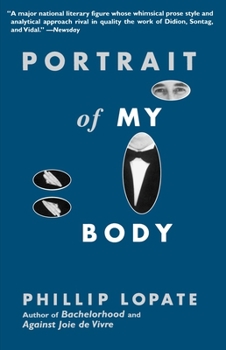
Portrait of My Body: A Memoir in Essays


Select Format
Select Condition 
Book Overview
Phillip Lopate's richest and most ambitious book yet--the final volume of a trilogy that began with Bachelorhood and Against Joie de Vivre--Portrait of My Body is a powerful memoir in the form of interconnected personal essays. One of America's foremost essayists, who helped focus attention on the form in his acclaimed anthology The Art of the Personal Essay, Lopate demonstrates here just how far a writer can go in the direction of honesty and risk taking. In thirteen essays, Lopate explores the resources and limits of the self, its many disguises, excuses, and unmaskings, with his characteristic wry humor and insight. From the title essay, a hilarious physical self-exam, to the haunting portrait of his ex-colleague Donald Barthelme, to the bittersweet account of his long-delayed surrender to marriage, "On Leaving Bachelorhood," Lopate wrestles with finding the proper balance between detachment and empathy, doubt and conviction. In other essays, he celebrates his love of film and city life, and reflects on his religious identity as a Jew. A wrenchingly vivid, unforgettable portrait of the author's eccentric, solipsistic, aged father, a self-proclaimed failure, is the centerpiece of a suite of essays about father-figures and resisted mentors. The book ends with the author's own introduction to fatherhood, as witness to the birth of his daughter. A book that will engage readers with its conversational eloquence, skeptical intelligence, candor, and mischief, Portrait of My Body is a captivating work of literary nonfiction.
Format:Paperback
Language:English
ISBN:0385483775
ISBN13:9780385483773
Release Date:September 1997
Publisher:Anchor Books
Length:336 Pages
Weight:0.88 lbs.
Dimensions:0.9" x 5.5" x 8.4"
Customer Reviews
3 ratings
Appreciating the Personal Essay (part 2)
Published by Thriftbooks.com User , 17 years ago
I liked Lopate's Against Joie de Vivre enough to purchase Portrait of My Body a few weeks later. Again, Lopate delves into himself and presents his findings with self-deprecation, where warranted, and assertion, even indignance, where it makes sense. It's a pleasure to find someone who expresses himself so well and with such uncommon sense. If his essays have a flaw, it's in his overaffection for the past. Lopate knows this aspect of himself, and says as much: the desire to dwell in rich remembrance of certain times and places; an inclination I share with him, and that accounts of much of the rewriting I do on my own things. At times, it waylays his clear-eyed observations, and perhaps his judgment, as in his clunker in Joi de Vivre: an overlong essay on Houston, which had become his adopted city. In this book, it affected by his portrait of the West Village, a place I know too, and in a similar manner: he lived on Bank Street, and I was around the corner on Perry, at roughly the same time, and both of us were looking back while we were there. Contemplating those narrow, old-fashioned streets, recalling his bohemians, nostalgia nudges enough of his acuity aside that his piece comes to rest too much on the personalities of two literary characters he knew. They become personifications of the place; a tricky gambit to describe the past. Then again, perhaps it's because Lopate's highs are so high that they call attention to the pieces that fall short. And in this book, what he has to say about the contemporary Jewish attitude toward the concentration camps--the Holocaust, as it's all but universally called now, which he critically examines--sums up and goes beyond the arguments a Jew hears at Passover, and in fact just about whenever the state of Isreali comes up in conversation.I Think, Therefore Who Am I?
NOT A SOUR NOTE
Published by Thriftbooks.com User , 18 years ago
I've read almost nothing but memoirs in recent years and have been moved on some level by most of them, so it wasn't just the humanity and candor that got to me, reading Phillip Lopate's "Portrait of My Body." The quality of Lopate's writing reminded me of what true literature sounds like: lines to linger on, just for the music. His portraits of self, people and places he's loved are affectionate but unsparing (his ode to his father, for example, is a masterpiece of balance). It's not the most emotionally turbulent batch of confessions on the shelves: people die of natural causes, fall from grace without bleeding on everything... but personal truth is always a sensation when it's this authentic and sublime.
America's Essayist Laureate scores
Published by Thriftbooks.com User , 22 years ago
To read anything by Philip Lopate is a privilege. To sit at his feet in a seminar is an honor. I had that experience at a writing conference in Santa Fe about 4 years ago, and it was a very powerful catalyst to my own writing career. The man is a consummate teacher, wise, witty, and wonderful.So is this book. A collection of 13 essays, Portrait of My Body is an honest delving into the depths of `self.' Read it for many reasons. Read it to learn more about Lopate himself, and in the process you will learn more about yourself. Read it to learn a subtle but strong lesson on the craft of writing the personal essay. Read it to learn a contrarian Jew's take on the "Holocaust rhetoric." Read it most of all to get a peek into long-time and avowed bachelor Lopate's wry and sweetly resigned dive into marriage and fatherhood. Whatever. Just read it.
Copyright © 2026 Thriftbooks.com Terms of Use
| Privacy Policy | Do Not
Sell/Share My Personal Information | Cookie Policy | Cookie Preferences | Accessibility Statement
ThriftBooks® and the ThriftBooks® logo are registered trademarks of Thrift Books Global, LLC
ThriftBooks® and the ThriftBooks® logo are registered trademarks of Thrift Books Global, LLC
