


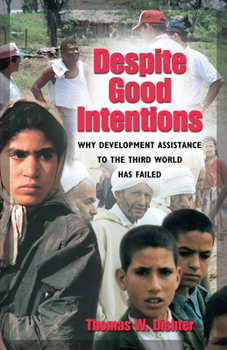
Despite Good Intentions: Why Development Assistance to the Third World Has Failed

Select Format
Select Condition 
Book Overview
For more than thirty-five years, Thomas W. Dichter has worked in the field of international development, managing and evaluating projects for nongovernmental organizations, directing a Peace Corps country program, and serving as a consultant for such agencies as USAID, UNDP, and the World Bank. On the basis of this extensive and varied experience, he has become an outspoken critic of what he terms the "international poverty alleviation industry." He believes that efforts to reduce world poverty have been well-intentioned but largely ineffective. On the whole, the development industry has failed to serve the needs of the people it has sought to help. To make his case, Dichter reviews the major trends in development assistance from the 1960s through the 1990s, illustrating his analysis with eighteen short stories based on his own experiences in the field. The analytic chapters are thus grounded in the daily life of development workers as described in the stories. Dichter shows how development organizations have often become caught up in their own self-perpetuation and in public relations efforts designed to create an illusion of effectiveness. Tracing the evolution of the role of money (as opposed to ideas) in development assistance, he suggests how financial imperatives have reinforced the tendency to sponsor time-bound projects, creating a dependency among aid recipients. He also examines the rise of careerism and increased bureaucratization in the industry, arguing that assistance efforts have become disconnected from important lessons learned on the ground, and often lessons of world history. In the end, Dichter calls for a more light-handed and artful approach to development assistance, with fewer agencies and experts involved. His stance is pragmatic, rather than ideological or political. What matters, he says, is what works, and the current practices of the development industry are simply not effective.
Format:Paperback
Language:English
ISBN:155849393X
ISBN13:9781558493933
Release Date:January 2003
Publisher:University of Massachusetts Press
Length:320 Pages
Weight:0.25 lbs.
Dimensions:0.9" x 6.1" x 9.6"
Grade Range:Postsecondary and higher
Customer Reviews
4 ratings
A must read for any modern politico
Published by Thriftbooks.com User , 19 years ago
This book is the keystone of any collection on the state of the art in modern thought on development assistance. It is easy to read, easy to understand, and presents a persuasive argument for change to the modern methods of so called "development." This books usefulness is not limited to the third world, as its lessons can apply just as easily to New Orleans as it can to the Congo. I first checked this out from the library, but I'm now picking up a copy (or maybe two) so I can have it on my shelf to cite from and to loan to friends and family. Highly reccomended.
great overview of the industry, but ...
Published by Thriftbooks.com User , 20 years ago
Dr. Dichter gives a wide range of examples based on real experiences that expose many of the pitfalls of development assistance as we know it. Unfortunately, while his descriptions of the problems are quite comprehensive, his proposed solution (i.e. drastically cut development assistance in favor of private development) lacks much in the way of logical support. For instance, there is no contrasting presentation of examples of privately-funded projects that have succeeded where charity has failed, nor any mention of to what extent business relies on government-funded infrastructure improvements, etc. In addition, the topic is best addressed in two stages -- i.e., is it desirable to encourage development in other countries? and, if so, are our current tactics the most effective and efficient ways to achieve this goal? Dr. Dichter addresses only the second question, but seems to conclude that because the status quo is ineffective, the entire pursuit should be abandoned. But in general the book is still highly worth reading if you're the least bit interested in development assistance -- it is both deeply enlightening and generally accessible.
A Pragmatic Take At A Noble Dream
Published by Thriftbooks.com User , 21 years ago
It's one of those (few) publications that would immediately make you sit up straight, cause you to squirm and shake your head in disbelief, heave a deep sigh, raise your eye brows at some point, and move you deeply to show appreciation to its material by graphically interacting with its content (in other words scribbling all over the pages of the book - line by line, margin to margin - with notes and personal reactions. That happened to my copy. That's how interesting the book is!). No, the book is not trashy and is far from cynical. On the other hand, it offers a very reflective, comprehensive and insightful analysis of the mistakes and failures of the development industry as a whole. The author, a "devbiz" insider, is not an anti-INGO humbug but one who calls on his development colleagues to re-examine their (and their organizations') ways and to genuinely consider the often ignored realities in the field. His analysis of the evolution of the development industry and its trends, patterns and pitfalls are based on actual case studies and historical facts. Full of relevant lessons and thought-provoking questions and issues that would challenge not just your notions of development work but even your own values, motives and goals for entering the "devbiz" industry. The book stimulates mentally but tugs at the heart.
Excellent description of the "development industry"
Published by Thriftbooks.com User , 21 years ago
Mr. Dichter has written an excellent book about the so called "development industry". He describes the evolution of the idea of helping the poor countries of the so called third world since 1950 until today. He discusses the problems that have arisen in the hundreds of governement development agencies, NGOs, and humanitarian organizations, mainly the excessive professionalization and bureaucratization of these organizaitons. The "industry" of development as he calls it, exists mainly to give emplyment opportunities for well paid (and well travelled)consultants than to really help the needy.Interwoven in his analysis are 18 case stories. Just reading the case stories (which are based in the author's wide professional experience)gives you a better insight in the dilemma of development, than dozens of World Bank, IMF and "imperialism" bashing books that are in the market. The description of how the World Bank ticks is very interesting. You feel that here someone is writing that has gone through all this and has thought about it. THIS IS REALITY and not theory.I myself have worked in Africa for 5 years as an economist for a Christian Mission Society. It is amazing to see that everywhere in the field the problems are the same: poorly conceived projects, neglect of the consequences of projects, and so on. If you are ever thinking of working in the area of international development, AND if you really want to help the poor, AND NOT MAKE A CAREER OUT OF IT, READ THIS BOOK!!!
Copyright © 2025 Thriftbooks.com
Terms of Use | Privacy Policy | Do Not Sell/Share My Personal Information | Cookie Policy | Cookie Preferences | Accessibility Statement
ThriftBooks ® and the ThriftBooks ® logo are registered trademarks of Thrift Books Global, LLC
ThriftBooks ® and the ThriftBooks ® logo are registered trademarks of Thrift Books Global, LLC
