


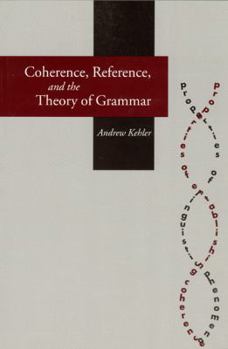
Coherence, Reference, and the Theory of Grammar
No Customer Reviews

A natural language discourse is more than an arbitrary sequence of utterances; a discourse exhibits coherence. Despite its centrality to discourse interpretation, coherence rarely plays a role in theories of linguistic phenomena that apply across utterances. In this book, Andrew Kehler provides an analysis of coherence relationships between utterances that is rooted in three types of 'connection among ideas' first articulated by the philosopher David Hume - Resemblance, Cause or Effect, and Contiguity. Kehler then shows how these relationships affect the distribution of a variety of linguistic phenomena, including verb phrase ellipsis, gapping, extraction from coordinate structures, tense, and pronominal reference. In each of these areas, Kehler demonstrates how the constraints imposed by linguistic form interact with those imposed by the process of establishing coherence to explain data that has eluded previous analyses. This book will be of interest to researchers from the broad spectrum of disciplines from which discourse is studied, as well as those working in syntax, semantics, computational linguistics, psycholinguistics, and philosophy of language. It is crucial reading for those studying the specific problems addressed in the book, which include discourse coherence, ellipsis, gapping, extraction from coordinate clauses, tense, and pronominal reference.
Format:Paperback
Language:English
ISBN:1575862166
ISBN13:9781575862163
Release Date:January 2002
Publisher:Center for the Study of Language and Informat
Length:200 Pages
Weight:0.72 lbs.
Dimensions:0.5" x 6.0" x 9.0"
Related Subjects
Language ArtsCustomer Reviews
0 rating
Copyright © 2025 Thriftbooks.com
Terms of Use | Privacy Policy | Do Not Sell/Share My Personal Information | Cookie Policy | Cookie Preferences | Accessibility Statement
ThriftBooks ® and the ThriftBooks ® logo are registered trademarks of Thrift Books Global, LLC
ThriftBooks ® and the ThriftBooks ® logo are registered trademarks of Thrift Books Global, LLC
