


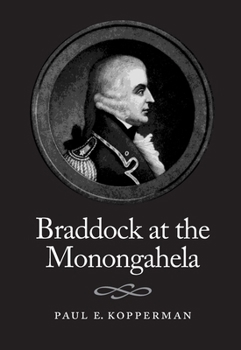
Braddock At The Monongahela (Regional)

Select Format
Select Condition 
Book Overview
On July 9, 1755, an army of British and American soldiers commanded by Major General Edward Braddock marched toward a major western outpost held by the French, confident of an easy victory. Suddenly, they were attacked by a much smaller force of French and Indian fighters-Braddock's army was destroyed, its commander fatally wounded, and supplies and secret papers were lost to the enemy. Paul E. Kopperman has used all of the known eyewitness reports of Braddock's defeat-some never before printed-to present an exciting critical account of this definitive battle in the French and Indian War. Braddock at the Monongahela is a synthesis of in-depth analysis of primary source materials, thoughtful evaluation of previous studies on the subject, and Kopperman's own persuasive interpretation.
Format:Hardcover
Language:English
ISBN:0822933268
ISBN13:9780822933267
Release Date:January 1977
Publisher:University of Pittsburgh Press
Length:360 Pages
Weight:1.20 lbs.
Dimensions:8.3" x 0.8" x 5.8"
Related Subjects
Colonial Period England Europe History Military Modern (16th-21st Centuries) Revolution & FoundingCustomer Reviews
4 ratings
The Braddock disaster: an excellent account and source book
Published by Thriftbooks.com User , 19 years ago
This is a fascinating book and remains one of the best in presenting original source material regarding Braddock's expedition to Fort Duquesne in 1755. Kopperman begins by reconstructing the battle scene as completely as possible based on contemporary accounts; he then analyzes these accounts attempting to find holes in them. The book becomes an important exercise in trying to determine historical truth, RASHOMON-style: how accurate are the so-called eyewitnesses, and what prejudices and degrees of self-interest, not to mention the "tricks" of empirical evidence, are at play in the making of clear judgments are examined by Kopperman. An historian willing to give Braddock his due, he is somewhat dismissive of the harshest criticisms leveled against him. Rather than poor generalship, Kopperman places greater fault for the disaster at the feet of the soldiers themselves, especially their failure to follow orders. He believes if the men had massed and conducted a bayonet charge, they could (he's careful here, and refuses to say would) have routed the enemy. Some have accused Braddock of being a martinet, which Kopperman discounts. Other charges against the General include not heeding advice from subordinates, showing contempt for the Indians and Americans taking part in the expedition, and being an ineffectual leader of men and poor military tactician - charges that Kopperman carefully examines but finds wanting (sometimes he seems TOO willing to give Braddock the benefit of the doubt). In the second half of the book he records both British and French accounts of the battle and critiques each one. Again he tries to determine the accuracy of these accounts and to call attention to what he considers mere conjecture or clear errors. It's good having these reports, some of them never before printed, where the reader can evaluate for herself their importance as well as seeing Kopperman's viewpoints. Also included are maps drawn by eyewitnesses at the battle, and a map of the battle site today. The book is an excellent one, a must-read account of the Braddock disaster in western Pennsylvania.
Braddock on the Monogahela reprinted at last!
Published by Thriftbooks.com User , 22 years ago
Not before time Paul Kopperman's book `Braddock on the Monongahela' has been reprinted. Published as far back as 1977 and yet it still remains the most perspicacious analysis of the battle. The first 130 pages provide a stylish narrative and commentary that would be hard to exceed. The remaining 200 pages commence with an excellent bibliographic essay that reviews the historiography of the Braddock Defeat and is a model of its kind. This is followed by an assessment of the reliability of the account of Robert Orme, who was an Aide de Camp to General Braddock.Orme provides one of the most complete accounts of the expedition and he was at the forefront of the contemporary defence of Braddock's reputation. Most secondary accounts rely very heavily on Orme's testimony although the distinguished historian Stanley M Pargellis cast doubts on Orme's motives and reliability in the decades between the wars. Kopperman weighs all this in the balance and comes to his own judgement which he tests against other eyewitness statements and recounts his analysis with a precision which is a joy to read.The final slice of the book comprises reprints of eyewitness accounts from both British and French sources (some seen for the first time herein) together with Kopperman's assessment of their relative merits. Much of this documentation is not easy to access so in reprinting those items that relate to the battle the author allows to the reader the opportunity to indulge in historical interpretation on his/her own account.This is a first rate piece of historical writing and justly deserves to be reprinted. The prose is stylish, the analysis clear and original. It is the one book on Braddock's Defeat that anyone with an interest cannot afford to be without. Buy this book now!
Too bad this is out of print...
Published by Thriftbooks.com User , 23 years ago
This is a wonderful book of first-hand accounts and analysis of infomation regarding Braddock's defeat on the Monongahela in 1755. On the dust jacket, written by a fellow named R. Alberts, one may read the following, "An original and important work. The scholarship is of a high order, and the writing has both clarity and style. It is the best analysis yet of the source material on Braddock's defeat. It gathers together for the first time all the known eyewitness accounts of the Defeat, including several that were previously unpublished or untranslated." I couldn't have said it better myself. If one is looking for a narrative of the battle, a book such as "Guns at the Forks," by Walter O'Meara would be better, but if one is looking for original source material from which other stories and narratives were written, then this is the book to own. This book is excellent. In the first half of the book, the author tells the story of Braddock's defeat, giving an analysis of the source material used for the information. Afterwards there is a short section concerning the numerous books written this episode of history. The rest of the book consists of original source material and the authors comments on them as to their reliability. For example, when commenting on an officers report to his superiors, the author points out that the report may be slanted to make the writer appear "better" in the eyes of his superior officer. There are several French accounts included also, which I have never seen anywhere else (well, I might have, but this is the first time I could read them as the other accounts I have seen are still in the original French, and I can't read French--here, the author translates them, which is obviously a great deal of help to those of us who can't read French!). The sources Kopperman uses are extensive, and his comments are well thought out, informative and just just plain well written. This is a "must have" book for anyone interested in this episode from history. For what this book advertises intself to be, it is excellent in every regard. (And unlike another reviewer, I am not related to the author in any way!)
Scholarly Research Disproves the Myths
Published by Thriftbooks.com User , 23 years ago
Review update: Since this book is now in print again, I recently purchased it and just finished re-reading it. I was again enormously impressed with what an excellent work it is. Professor Kopperman presents nothing less than the definitive work on this topic, clearly the result of thorough research and IMO a near flawless analysis of difficult (and often contradictory) source materal. Even having now passed the 250th anniversary of the Battle of the Monongehela, there is still a disturbing amount of junk-history floating around about the battle and Edward Braddock. It seems that not enough people have consulted this book and learned their subject better before they expound on it. Buy this book now while you can. Even if your interest in the topic is only moderate, the book may cause you to reflect on how strangely garbled commonly accepted history may be, when contrasted with carefully researched facts. Original review: I read this book some time ago and found it to be a tremendously helpful work in revealing a truer understanding of a hugely misunderstood and misrepresented historical figure and the events surrounding his tragic battle. As one who grew up in the region where the events happened, and having done some independant research and writing on the topic, I can attest that most of the conventional wisdom about Edward Braddock and the Battle of the Monongahela is so distorted that almost no one relates the true facts anymore (if they ever did). Kopperman dug deeply into source documents, with particular focus on contemporaneous accounts of those who were present. The author states that he was not out to necessarily rehabilitate Braddock's reputation, nor to vilify it either, but to look through the wall of legend and onto what really occurred with Braddock's expedition to Fort DuQuesne and why. By examining the best surviving evidence and contemporary documentation, including an examination of the motives behind who wrote what, a better and objective understanding can be gained. If you must read just one book on this topic, this would be the one to get.
Copyright © 2025 Thriftbooks.com
Terms of Use | Privacy Policy | Do Not Sell/Share My Personal Information | Cookie Policy | Cookie Preferences | Accessibility Statement
ThriftBooks ® and the ThriftBooks ® logo are registered trademarks of Thrift Books Global, LLC
ThriftBooks ® and the ThriftBooks ® logo are registered trademarks of Thrift Books Global, LLC
