
Skip to content
Scan a barcode
Scan
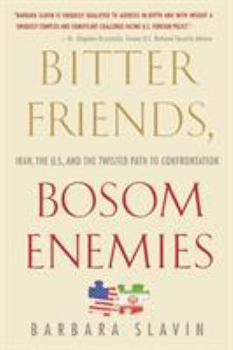
Paperback Bitter Friends, Bosom Enemies Book

ISBN: 0312384912

ISBN13: 9780312384913

Bitter Friends, Bosom Enemies

Select Format

Select Condition ThriftBooks Help Icon

Recommended

Format: Paperback

Condition: Good

$6.29
Save $16.70!
List Price $22.99
Almost Gone, Only 1 Left!

Book Overview

In Bitter Friends, Bosom Enemies, Barbara Slavin untangles the love-hate relationship between Iran and the United States that has brought the two countries to the brink of war. Slavin reveals that relations between Washington and Tehran have been riddled with contradictions for decades and details missed opportunities for reconciliation under both the Clinton and Bush administrations, including diplomatic rebuffs to Iran in Bush's first term based on the mistaken belief that the U.S. invasion of Iraq would weaken Iran's Islamic government. On e of the few reporters to interview high-profile Iranian officials, including Iran's current and last two presidents, Slavin describes all the key constituencies in Iran society from the clerics, to the Revolutionary Guards, to reformers and Iranian youth. She unveils Iran and shows it to be a country that both adores and fears the United States. Despite government propaganda that portrays the U.S. as the "Great Satan," many Iranians have come to idolize staples of American pop culture while holding on to their own traditions. The United States, on the other hand, has demonized Iran as a member of an "axis of evil" that supports terrorists and represses its own people who, in the words of U.S. officials, "deserve better." As Iran moves toward becoming a nuclear power, Slavin believes that the power brokers in Washington may be suffering from the same lack of understanding and foresight that led the U.S. into prolonged warfare in Iraq. Distrustful of each other's intentions yet longing at some level to reconcile, neither Tehran nor Washington knows how this story will end. Anyone interested in understanding the dynamics of this pivotal international relationship will find Bitter Friends, Bosom Enemies a crucial and compelling read.

Customer Reviews

5 ratings

Must Read for Anyone Who Better Wants to Understand Iran

Bosom Enemies, Bitter Friends is an excellent book not only for people who have spent a lifetime studying Iran, but also for the educated person who may understand foreign relations, but really know little about Iran and what governs its relations with the U.S. The book is encyclopedic in terms of the amount of information that is packed into it, everything from how both sides have squandered opportunities to the current regime to the development of Iranian youth culture. One cannot but learn 100% more than when one started. A must read for anyone who wants to really understand Iran (not what the media and/or administration want us to believe). With any luck, the sequel is in progress.

Diplomatic challenge and failure

This book is a timely journalistic account that provides some insight into the enigma of Iran. During the late 70s Iran rose to the top of the news in the United States when as a reaction to the Westernizing influences of the Shah, Ayatollah Khomeini rose to power, referred to the U.S. as the "Great Satan", American hostages were taken, and Iranians demonstrated in the streets chanting "death to America". There followed a period of relative silence during which Iran tried to mend itself after the ravages of the Iran-Iraq War and then actually reform itself during the Khatami presidency. Lately, it has risen again to prominence in the news, this time as the bugaboo of the Bush Administration, as part of the "axis of evil". The author made a series of visits to Iran starting in 1996, and has structured this book principally on the basis of her observations, interviews with Iranian and American officials, and talks with ordinary Iranians. What we get here is a picture of a country that has a very tangled government - the author compares it to an American square dance - in which the ultimate arbiter is the supreme religious leader, the Ayatollah Khamenei. Though some change has occurred (notably during Khatami's presidency and as a result of globalization) and there are some democratic elements, Iran is still a very long way from having any clear separation between the state and an authoritarian religion. The Shiite form of Islam dominates and tries to extend its influence to other parts of the Middle East such as Iraq and Lebanon. The Iranian city of Qom, the "mullah factory", is along with Najaf in Iraq the center of Shiite Islam; and is described as something like a medieval enclave where religious law is rigorously taught and applied. This religion is steeped in the masculine Old Testament tradition of the desert, in which woman are largely excluded. It's myths feature the twelfth Imam, a Messianic figure who will return some day to save believers. During the Clinton Administration diplomatic overtures were made to Iran, small steps taken with quite a lot of discretion in view of terrorist acts attributed to the Iranian Revolutionary Guard. Those overtures gained momentum when President Khatami took office and the "death to America" signs started coming down. After 9/11 Iran responded with sympathy and held candlelight vigils, unlike other Islamic countries. At that point, the United States had much in common with Iran: Saddam Hussein and the Taliban were both mutual enemies; Iran had fought a war against Saddam and almost gone to war with the Taliban. And, in fact, Iran cooperated with the U.S. aims in Afghanistan and provided assistance to the Northern Alliance in turning back the Taliban. It could have been a perfect time to establish diplomatic relations, but the Bush Administration was too busy exerting its dominance. Bush proceeded to label Iran as part of an "axis of evil". Then, the Administration squandered an opportunity for peaceful

Insights into Iran

Slavin's book is very interesting. This book provides an insight to many of Iran's leaders, clerics and governmental. She does give the reader a sense of the people of Iran and their desire for peace. She points out the inner turmoil within Iran on the duality of leadership; those who are liberals with the desire for western ideas, dress and democracy and those who are hard liners with religious convictions. Ms. Slavin points out the frustration of the Clinton and Bush administration in trying to negotiate dialog and meaningful relations with Iran, however, she also points out the underlying mistrust between the U.S. and Iran. Of course, much of the mistrust goes back in history to 1979 and also the spoken words or unspoken words between the two countries. She points out that the "Axis of Evil" speech of President Bush may have done more damage to relations than some may have thought. This book is well written, documented and a must read if understanding the middle east, Iran's role there and in the world is important.

Accessible Truth

How many Americans know how the Iranian system of government works? Are Americans aware that Iran's population is mostly under thirty and restless? Do Americans realize that Iran is more complex than their mere portrayal as an Islamic fascist state? One wonders if Americans have thought about the internal dynamics of Iranian society? Sadly, most Americans don't realize that a hunger for democratic reform exists in Iranian society and war will likely only rally their people to the regime which oppresses them. Our newspapers, television, radio and online sources are busy quoting outrageous statements from the Iranian president Mahmoud Ahmadinejad and America's fear about their nuclear program. Jingoistic sound-bites on both sides have dwarfed sensible, thoughtful and fact based commentary. Thankfully, Barbara Slavin has written a book that presents a holistic view we Americans are typically not exposed too. Using her remarkable access to people such as Madeline Albright, Condelezza Rice, Iranian reformers like former President Mohammad Khatami, longtime establishment figures such as Ali Rafsanjani, as well as dissidents like Akbar Ganji and everyday citizens, allows Slavin to shed sunlight on a nation most Americans know very little about. She was the first newspaper journalist to interview Iranian President Ahmadinejad. We also learn about the tantalizing opportunities for reconciliation not seized by three successive American administrations. Overall, Slavin's prose is anecdotal but fact based. Her book makes truth accessible and truth about Iran has been in short supply. Hopefully, her book will also make truth fashionable again. For more information about Slavin's book and insights into Iran, listen to a podcast interview I had with her at the weblog, Intrepid Liberal Journal.

Must Reading

With all the mounting talk about a possible war with Iran, "Bitter Friends and Bosom Enemies" is a must read for anyone concerned about the misguided direction of the current Administration's foreign policies. The author has obviously spent a lot of time in Iran and she takes the reader there with her in this insightful, lively and well-written book. Much is written in the news these days about the threat Iran poses, but little if any of it explains why. This book helps to fill that gap, increasing the reader's understanding of the country, its people and, as the author puts it, the complicated "square dance" of Iranian politics. Most importantly for Americans, it shows how the clash of two faith-based foreign policies--Tehran's and Washington's--is setting our two countries on a tragic and needless path to confrontation. Highly recommended!
Copyright © 2026 Thriftbooks.com Terms of Use | Privacy Policy | Do Not Sell/Share My Personal Information | Cookie Policy | Cookie Preferences | Accessibility Statement
ThriftBooks® and the ThriftBooks® logo are registered trademarks of Thrift Books Global, LLC

GoDaddy Verified and Secured