


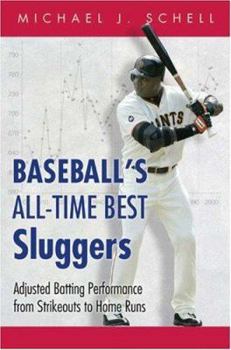
Baseball's All-Time Best Sluggers: Adjusted Batting Performance from Strikeouts to Home Runs

Select Format
Select Condition 
Book Overview
Over baseball history, which park has been the best for run scoring? (1) Which player would lose the most home runs after adjustments for ballpark effect? (2) Which player claims four of the top five places for best individual seasons ever played, based on all-around offensive performance? (3) (See answers, below).
These are only three of the intriguing questions Michael Schell addresses in Baseball's All-Time Best Sluggers, a lively examination of the game of baseball using the most sophisticated statistical tools available. The book provides an in-depth evaluation of every major offensive event in baseball history, and identifies the players with the 100 best seasons and most productive careers. For the first time ever, ballpark effects across baseball history are presented for doubles, triples, right- and left-handed home-run hitting, and strikeouts. The book culminates with a ranking of the game's best all-around batters. Using a brisk conversational style, Schell brings to the plate the two most important credentials essential to producing a book of this kind: an encyclopedic knowledge of baseball and a professional background in statistics. Building on the traditions of renowned baseball historians Pete Palmer and Bill James, he has analyzed the most important factors impacting the sport, including the relative difficulty of hitting in different ballparks, the length of hitters' careers, the talent pool from which players are drawn, player aging, and changes in the game that have raised or lowered major-league batting averages. Schell's book finally levels the playing field, giving new credit to hitters who played in adverse conditions, and downgrading others who faced fewer obstacles. It also provides rankings based on players' positions. For example, Derek Jeter ranks 295th out of 1,140 on the best batters list, but jumps to 103rd in the position-adjusted list, reflecting his offensive prowess among shortstops. Replete with dozens of never-before reported stories and statistics, Baseball's All-Time Best Sluggers will forever shape the way baseball fans view the greatest heroes of America's national pastime. Answers: 1. Coors Field 2. Mel Ott 3. Barry Bonds, 2001-2004 seasonsFormat:Hardcover
Language:English
ISBN:0691115575
ISBN13:9780691115573
Release Date:February 2005
Publisher:Princeton University Press
Length:408 Pages
Weight:1.55 lbs.
Dimensions:1.2" x 6.4" x 9.6"
Customer Reviews
5 ratings
michael schell's first book on statistical methods applied to baseball
Published by Thriftbooks.com User , 17 years ago
Michael Schell is a professor of statistics at the University of North Carolina. I find that we have much in common. Like him, I work in biostatistics and also I am a great fan of baseball. An age old question in baseball is who is the greatest home run hitter of all time. Maturally Babe Ruth is usually the first name that comes to mind. At the time this book was written the use and affect of steroids on home run hitting was not as evident as it is today. The home run explosion of the 1990s with McGwire, Sosa and Bonds as the key sluggers was viewed as being based more on exceptional talent. We now know that all these players probably used steroids and steroid use may be a key factor in this performance. Putting that aside Mike Schell uses classical statistical regression models to adjust home run total for effects that don't relate to talent. One of the most important factors is the nall park effect. Everyone knows that Boston's Fenway Park is far different in shape and home run potential than say Yankee Stadium or Dodger Stadium and before the idea of humidifying baseballs to compensate for the altitude Coors Stadium gave up the most home runs by far. Since ball players play half their games in their home park their home run total is naturally affected by the home field. So without adjustment for the home field it would be impossible to compare even contemporary sluggers among themselves. With DiMaggio being a right hand hitter playing in Yankee Stadium the ball park hurt his home run production. As a left handed pull hitter in Fenway park Williams did not reap the advantages of the left field Green Monster. Yankee Stadium favored left hand pull hitters thus helping hitters like Roger Maris but hurting the right hand power alley hitters like DiMaggio. One interesting question is how would Williams playing for the Yankees and DiMaggio for the Red Sox have affexted their hone run production. The models that Schell develops in this book could be used to construct "statistical" answers to such questions. However, I think his main goal was to rank the all time best home run hitters adjusting for the home field and the era in which the player played the game. The results are interesting and sometimes lead to big surprises. Later on Mike ventured into the question of who the best hitters were using similar models. This was the subject of his second book in which he claimed that Tony Gwynn and not Ty Cobb was the all-time greatest hitter based on the rankings derived from the models. For home runs Bonds clearly stood out over the rest. In his best years he got record numbers of walks including an amazing number of intentional walks. This meant that his amazing home run total came with the handicap of not getting as many opportunities to hit compared to an average player. Today's skeptics could rightly say that it was steroids as much or more than talent that gave him the opportunity to produce so many home runs. Other books sim
Statistical Review
Published by Thriftbooks.com User , 20 years ago
I think the book is an excellent addition to the work of adjusting baseball statistics because it takes into account many aspects in making adjustments to player batting statistics, not just adjusting for ballpark factor. My only concern is whether it is proper to adjust non-normal statistics to a normal bell curve when making adjustments.
One nice piece of work and a great presentation
Published by Thriftbooks.com User , 20 years ago
Schell states the problem, tells you how he's going to analyze the problem and then presents a great read. If you want the details, there included at the end of the book. Just a great approach with solid logic. Two additional points: 1. If you are playing Fantasy Baseball (especially "Old-Timer") then you need this book and the Bill James Historical Abstract. Any other book is a very distant 3rd. 2. For baseball statistics/methods, this book is the best book out there and is addictive. That's why I bought it and I've been spending hours reading this book. It's an excellent reference and I can't find any fault with it.
Excellent Book - Don't Confuse it with Schell's Other One
Published by Thriftbooks.com User , 20 years ago
I am almost certain that the first two reviewers of this excellent book are confusing Schell's content in this book with the one he previously released. Mr. Schell has another book entitled "Baseball's All-Time Greatest HITTERS" in which he concludes that Tony Gwynn was the greatest HITTER of all-time. I can easily understand the mis-interpretation of "All-Time Best Sluggers," as Mr. Schell includes several tables, charts, graphs and discussions that would lead an uninformed reader to assume this book was about HITTING instead of SLUGGING. Schell examines all sorts of topics in "Sluggers," ranging from discussions of pure power to ones of walk and strikeout frequency and success. If you do decide to pick up a copy of "Sluggers," do yourself a favor and also pick up a copy of "Hitters" and read it first. Doing this will give you a MUCH better understanding of the direction that Mr. Schell is taking with his newest book. He is looking at the numbers from all sides in "Sluggers," but his ultimate goal is to derive information about slugging, not pure hitting.
The best analysis of baseball statistics ever!
Published by Thriftbooks.com User , 20 years ago
One of the rules that I have lived by in my life is that time spent arguing baseball is by definition not wasted. Discussions over who was the best player ever are always subject to a myriad of scientific prejudices. It depends on your personal formulas in rating the relative values of the different kinds of hits, how you rate a walk and the value you associate with a stolen base. This book provides an enormous amount of analysis that assigns weights to those events and also incorporates other differences, such as the era of the player and the parks that he played in. As all fans know, the home park makes an enormous difference in the batting statistics of a player. A right-handed power hitter has an advantage in Fenway Park, as does a left-handed batter in Yankee stadium. The Houston Astrodome is a major liability for all power hitters and Coors field is a friend to all. Schell incorporates these differences in his analysis and then uses a weighted formula that includes all possible offensive contributions to create a ranking of the top 100 batters of all time. The top five are in order: Babe Ruth, Ted Williams, Rogers Hornsby, Barry Bonds and Lou Gehrig. He also computes clutch performance and adjusts for the effect of position on the field, including the designated hitter. While there are no surprises in the top ten, there was one omission that surprised me. All-time hits leader Pete Rose is not in the list and I didn't even find his name in the index of the book. This is one of the best baseball books of all time, although you do need to know something about statistics to understand the presentations. There are many charts, tables and graphs that reinforce the points being made. From now on, this book is my reference bible when the discussion turns to determining who was the better player.
Copyright © 2025 Thriftbooks.com
Terms of Use | Privacy Policy | Do Not Sell/Share My Personal Information | Cookie Policy | Cookie Preferences | Accessibility Statement
ThriftBooks ® and the ThriftBooks ® logo are registered trademarks of Thrift Books Global, LLC
ThriftBooks ® and the ThriftBooks ® logo are registered trademarks of Thrift Books Global, LLC
