


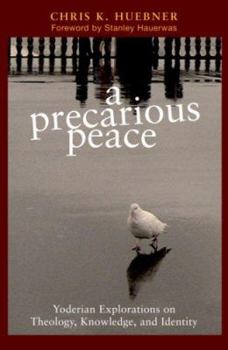
A Precarious Peace: Yoderian Explorations on Theology, Knowledge, And Identity (Polyglossia: Radical Reformation Theologies)


A Precarious Peace poses a formidable challenge to mainstream accounts of Christian pacifism. In place of an approach which seeks effectively to implement and distribute a peace whose content is known... This description may be from another edition of this product.
Format:Paperback
Language:English
ISBN:0836193415
ISBN13:9780836193411
Release Date:November 2006
Publisher:Herald Pr
Length:249 Pages
Weight:0.94 lbs.
Dimensions:8.8" x 0.5" x 5.8"
Customer Reviews
1 rating
Great Essays From a Brilliant Young Mennonite
Published by Thriftbooks.com User , 17 years ago
Huebner kicks off Polyglossia, a series from Herald press that he is co-editing, with his own book, A Precarious Peace, a timely book full of brilliant insights, which though it is often repetitive and overlapping, is nevertheless entirely enjoyable for it's variations on the theme of Christ's gift of peace. An imitation of Yoder's style right from the start, the book consists of essays written on assignment, some for graduate seminars at Duke (Hauerwas was his advisor), some for various ecumenical conferences, and some while on staff at CMU. Through and through this book is an attempt at decentering the Constantinian impulses towards totalization, security, and stability that plague so much of western theology. Huebner uses his position as a Mennonite as a vantage point from which to problematize established notions in theology, knowledge, and identity, all the while turning the interruptive message of the gospel against any static forms that the Mennonite community may be tempted to take. It is this that gives Huebner's book such credibility: a willingness to take seriously the way that the peace of Christ is disruptive to totality and finality. Ironically, the felt need to resist the conquering tone of colonial theology has tempted us "to invent new, less controversial and more sanitized, less threatening and more humanized images of theology, images like creative expression and human longing....Put bluntly, these more humanized images leave theology stripped of the ability to articulate how it is not at home in the world. They leave the theologian without the means to express the sense in which she is untimely and out of place, and so abandon her to identification with the vast empires and provincial colonies that define the world" (18). Huebner's project, then, is to search for new ways of exploring which foster genuine dialogue and engagements others based not on fear which seeks security, but on love which is willing to risk vulnerability. Put simply, Huebner is after what John Yoder calls a "methodological non-constantinianism." Much of pacifism ultimately undermines itself in its defense, since its apologetics are inherently violent. In seeking to batten down an airtight argument for why everyone must be non-violent, pacifism often embodies a violence in the way it engages other discourses, seeking total control and security from threats. This finds an acute expression in the occassional nature of theology for Yoder and Huebner. As it was for Yoder, Huebner's embracing of an occassionalism is no accident, but a purposeful strategy for attempting the totalizing discourses of systematic theology. But "the peace of Christ does not seek to make itself more secure and stable. It is radically unstable precisely because it exists as gift. Not only does it recognize that there are no final guarantees for the securing of peace, it understands that the pursuit of such guarantees is just another form of violence" In attempting to articulate a peac
Copyright © 2025 Thriftbooks.com
Terms of Use | Privacy Policy | Do Not Sell/Share My Personal Information | Cookie Policy | Cookie Preferences | Accessibility Statement
ThriftBooks ® and the ThriftBooks ® logo are registered trademarks of Thrift Books Global, LLC
ThriftBooks ® and the ThriftBooks ® logo are registered trademarks of Thrift Books Global, LLC
