


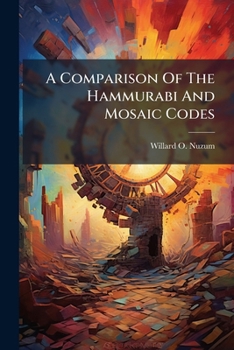
A Comparison Of The Hammurabi And Mosaic Codes

Select Format
Select Condition 
Book Overview
"A Comparison Of The Hammurabi And Mosaic Codes" examines two of the most influential legal systems of the ancient world. This study delves into the similarities and differences between the Code of Hammurabi, originating in ancient Mesopotamia, and the Mosaic Law, as presented in the Hebrew Bible. By comparing these two legal frameworks, the book sheds light on the development of legal thought and its impact on subsequent civilizations.
The work explores key aspects of each code, including their structure, specific laws, and underlying principles. It also considers the historical and cultural contexts in which these codes emerged, providing a nuanced understanding of their respective roles in shaping ancient societies. This comparison offers valuable insights into the evolution of legal and ethical norms and their enduring influence on Western legal traditions.
This work has been selected by scholars as being culturally important, and is part of the knowledge base of civilization as we know it. This work was reproduced from the original artifact, and remains as true to the original work as possible. Therefore, you will see the original copyright references, library stamps (as most of these works have been housed in our most important libraries around the world), and other notations in the work.
This work is in the public domain in the United States of America, and possibly other nations. Within the United States, you may freely copy and distribute this work, as no entity (individual or corporate) has a copyright on the body of the work.
As a reproduction of a historical artifact, this work may contain missing or blurred pages, poor pictures, errant marks, etc. Scholars believe, and we concur, that this work is important enough to be preserved, reproduced, and made generally available to the public. We appreciate your support of the preservation process, and thank you for being an important part of keeping this knowledge alive and relevant.
Customer Reviews
ThriftBooks® and the ThriftBooks® logo are registered trademarks of Thrift Books Global, LLC
