


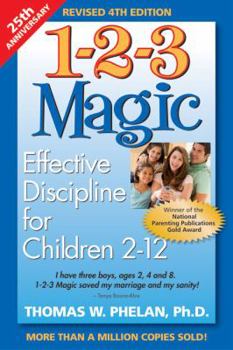
1-2-3 Magic


Select Format
Select Condition 
Book Overview
"Everywhere you go, you keep overhearing other moms say to their misbehaving children, 'That's one. That's two. That's three.' And then you watch in disbelief as their kid actually stops "--PopSugar... This description may be from another edition of this product.
Format:Paperback
Language:English
ISBN:1889140430
ISBN13:9781889140438
Release Date:January 2010
Publisher:Parentmagic Inc
Length:226 Pages
Weight:0.77 lbs.
Dimensions:9.0" x 0.5" x 6.3"
Customer Reviews
8 ratings
Wildly inappropriate and abusive
Published by Sick of this nonsense , 2 days ago
The author presents the idea of parents as "wild animal trainers" who must leverage power to ensure compliance. Many parents are tickled by this metaphor: does your house ever feel like a zoo? And the idea of a magical solution you can use to solve every problem in a few easy steps appeals to many exhausted parents who just want their kids to stop doing x. Unfortunately, relationships do not have a one-fits-all solution, and in order to maintain connection and foster true growth and understanding, you need to actually talk to your kids. If they're too young to talk, they are still communicating their needs in other ways. Crying and acting out are all communicating needs. And teenagers who act out on purpose *specifically* to upset you are STILL communicating a need....most likely the need for independence and autonomy. Communication is always the secret formula everyone is looking for.
A good rule for gauging whether child discipline is inappropriate is to imagine someone - your spouse, perhaps - doing it to you. Imagine your partner doing "1, 2, 3...TAKE FIVE" at you one day when you come home in a foul mood after a rough day at work. Not only is that not what you needed, but it's insulting and probably will create animosity between you and your partner. It has the same effect on children. Children are people who feel the same as we do, they just have a much less developed ability to self-regulate, problem-solve, and communicate than we do as adults. And that is to be expected. They are still learning, and we are here to help, not to assert dominance.
If you are thinking "well aren't ALL child discipline tactics really insulting when done to adults?" Yes, many of them are, and at times the fact that they cause harm is the intention; a little bit of "revenge" is worked into them for "stress relief" and social bonding between other frazzled adults. For an alternative that isn't going to ultimately hurt everyone, that will keep everyone's dignity intact, read "Kids Are Worth It!" by Barbara Coloroso instead.
The best solution for live in grandchildren!
Published by C Everson , 3 years ago
As grandparents with live in grandchildren, this has been very helpful in getting our home in order quickly
The best parenting book we have read
Published by ElenaEGB , 5 years ago
The best parenting book/advice we have been able to receive yet is from this book. Simple to follow, concrete in what you and your child are expected to do and applicable to many years of child-raising. My husband and I greatly recommend this book to other parents.
For my daughters daughter. Lol
Published by Connie , 7 years ago
Parents will find this helpful to discipline their children.
SImple y efectivo
Published by Thriftbooks.com User , 18 years ago
El autor trata a los nin~os como animales que deben ser domesticados. En ninguna parte se menciona la palabra amor o cariño (creo). Dicho esto, el libro presenta un metodo muy simple y eficaz para que los niños dejen de hacer algo indebido o desagradable. Tambien propone un metodo mas complejo y menos efectivo para estimularlos a que empiezen a hacer algo (como por ejemplo vestirse o irse a dormir). El metodo funciona y los consejos y distinciones son indespensables para criar en buena forma a un niño.
Muy útil.
Published by Thriftbooks.com User , 19 years ago
Es muy útil como una herramienta para educar niños sin el uso continuó del regaño y castigo, especialmente para padres primerizos.
A Sensible Philosophy that Worked for Us
Published by Thriftbooks.com User , 21 years ago
Tom Phelan presented a discipline program recently to my school district and he entertained and enlighted 300 parents of children of all ages. He was fabulous! He gave us many specific examples of what are kids do and say and what we can do differently to change their behavior. He addressed discipline regarding 2 types of behaviors... "Stop" behavior (like bad words, hitting, whining and disrespectful attitude)and "Start" behavior ( like getting the kids to do their homework, chores, clean up, use manners etc.) He emphasized that "the Magic" it is not so much the counting of...1, 2, 3 but rather how you choose to say it...in a calm yet athoritative manner so that the child knows the parent means business. He also talked about the importance of discussion outside the heat of the moment with the child either in a one-on-one discussion or a family meeting. Our 2-way communication with our children now involves more listening to one another and less lecturing. I realized that I had been doing the count all wrong expecting the magic to happen...threatening and screaming the numbers at the top of my lungs finding myself reaching 2 and 3/4...2 and 7/8 and feeling my kids were in total control and that I was a failure with the technique that was working so well for my neighbor. Listening to Dr. Phelan and reading his book taught me how to use this method correctly and to my surprise it is actually now working with my 6 and 8 year old. I have also found many other positive discipline strategies that work well on my 3 year old in another book called "The Pocket Parent", an A-Z parenting guide chock full of hundreds of suggestions of handling many challenging behaviors of 2-5 year olds. Both books are very compatible in philosophy and are worthy additions to your home library.
No Magic, but: Sane, Simple, Quick - with no yelling. Yay!
Published by Thriftbooks.com User , 27 years ago
I listened to the tape of this book while I commuted. In less than a week I was ready.Within 5 minutes our son understood the new 'rules of the game'. Within 2 days we had a more sane house. Yes, really.The discipline of the old days was 'spank your kid', and many of us reject this. The problem is that there wasn't a replacement that worked. So some parents keep spanking, some parents just yell all day. Either way, it's not a happy feeling of control. The basics of the 1-2-3 method are simple, kid-understandable, quick-to-implement, & quick to explain. (So you can even get care-takers, teachers, cub-scout leaders in on the game - to have some consistency.) But don't kid yourself - the real value is in understanding all of it.I don't believe I'm actually writing this but - just try it and you'll be a believer too.I loved the audio tape especially. In the first few minutes of the tape, the initial '1-2-3 Magic' is revealed. I wanted to start that day. Then examples, tactics for multiple kids and reinforcement follow. All of it is key to recognizing your kid's techniques for handling YOU, and creating the sane environment we all wish for.OK, life still isn't perfect, but this information goes a very long way to getting you out of the nightmare you might be in.I've bought copies for my sister, my friends, and my church. Every time I see a screaming parent and a crying kid, (or a nasty, defiant kid), I wish I had the nerve to give them a copy. No, I don't work for the author, but I sure would like to thank him. ;-)
Copyright © 2026 Thriftbooks.com
Terms of Use | Privacy Policy | Do Not Sell/Share My Personal Information | Cookie Policy | Cookie Preferences | Accessibility Statement
ThriftBooks ® and the ThriftBooks ® logo are registered trademarks of Thrift Books Global, LLC
ThriftBooks ® and the ThriftBooks ® logo are registered trademarks of Thrift Books Global, LLC
